

A consolidated portfolio can appear highly liquid while significant constraints remain within individual mandates. Aggregation can make access to capital look more uniform than it actually is, particularly when highly liquid mandates offset less-liquid allocations elsewhere.
Headline portfolio liquidity provides an incomplete picture of access to capital. It shows how much of the portfolio falls within a particular liquidity category, but not where constraints are concentrated or whether capital can be realised when the family needs it.
The Cecily Group’s independent reporting consolidates assets across managers while retaining these underlying liquidity distinctions, helping investment committees assess where capital is accessible and where constraints may require closer attention.
When “Illiquidity Is Temporary” Becomes an Inadequate Defence
A higher allocation to illiquid assets can be intentional. Private credit, private equity and other alternative investments may have long investment horizons by design. The governance question is whether the resulting constraints on access to capital are sufficiently understood and actively managed.
“We are not making any new illiquid investments”
A manager may expect the portfolio to become more liquid as existing investments mature. That depends on those assets realising capital according to plan. Extensions, delayed exits or changing market conditions can leave capital committed for longer than anticipated.
“The assets can still be sold if necessary”
An investment may have a secondary market even when it cannot be redeemed directly. The relevant question is then the price at which liquidity is available. An accelerated sale may require accepting a discount to the reported valuation, particularly where the underlying assets do not trade frequently.
Behavioural research provides another reason to scrutinise a strategy based primarily on waiting. Samuelson and Zeckhauser (1988) found a disproportionate tendency for decision-makers to maintain existing choices. While this does not explain an individual manager’s decision, it reinforces the importance of distinguishing a deliberate decision to retain an illiquid investment from allowing the existing allocation to persist.
The issue is therefore wider than whether the portfolio will eventually become more liquid. What happens when the family needs liquidity before the portfolio is ready to provide it?
How Liquidity Constraints Become Most Important Under Stress
Liquidity problems rarely begin when a family suddenly needs cash. They develop earlier, as capital is allocated across investments with different redemption periods, lock-ups and exit conditions.
Liquidity describes the ability to convert an investment into cash within a given timeframe. An investment’s reported value does not establish how quickly that value can be realised. Redemption periods, underlying asset liquidity and fund restrictions can all affect when capital becomes accessible.
A consolidated liquidity figure can make these differences difficult to see. Highly liquid assets held by one manager may offset less-liquid investments held by another, producing a strong portfolio-level figure even though access to capital varies substantially across mandates.
In normal markets, these differences may have little practical effect. Public securities can generally be sold quickly, while less-liquid investments remain invested according to their expected time horizons. The vulnerability becomes more apparent when the need for liquidity coincides with market stress.
Public assets may still be technically liquid during a market decline, but selling them can crystallise losses. At the same time, private credit, private equity and other alternative investments may take longer to realise, while fund-level redemption restrictions can further limit access to capital.
This creates structural liquidity asymmetry: the family’s reliance on readily saleable assets can increase precisely when selling those assets becomes least attractive, while access to less-liquid investments remains constrained.
The consequences extend beyond meeting immediate cash needs. Liquidity affects an investment committee’s ability to rebalance, respond to changing market conditions and move capital between managers or regions. When a significant allocation cannot be realised within the required timeframe, those choices become narrower.
When a Redemption Request Does Not Produce Cash
Consider an investment that remains valued within the portfolio but cannot be redeemed within the timeframe required. The investment committee may have already decided to exit, yet redemption terms, underlying asset liquidity or other restrictions prevent that decision from being implemented immediately.
This creates an important governance distinction between making an investment decision and being able to execute it. Once an exit decision cannot be implemented within the required timeframe, liquidity affects the family’s ability to exercise control over its capital.
The same issue becomes more significant when less-liquid investments accumulate within one mandate. A strong consolidated liquidity figure may conceal these concentrations if readily accessible assets elsewhere in the portfolio offset them at aggregate level.
For an investment committee, the relevant question is therefore whether sufficient liquidity remains available, from the right parts of the portfolio, when the family needs to act.
Detecting Where Liquidity Is Actually Available
A consolidated liquidity figure provides a useful overview, but it does not show where liquidity is concentrated or which managers contain the constraints. Combining liquidity analysis with mandate-level allocation data provides a clearer view of the underlying governance implications.
1. Liquidity Tier Analysis

Liquidity Tier Analysis
What it does: Classifies portfolio assets according to the expected time required to liquidate them: 0–5 days, 5–10 days, 10–30 days, 30–60 days and 60+ days.
Required inputs: Individual holdings, current market values and the applicable liquidation timeframe for each investment.
What it reveals: How much capital is expected to become available within different time horizons, distinguishing assets that can normally be realised within days from those requiring longer periods.
Why it matters: A liquidity percentage becomes more informative when the remaining assets are separated by the length of time required to realise them. This distinguishes assets that are accessible within days from those expected to require more time to realise.
Subtleties & Limitations
Liquidity classifications are estimates. The assigned timeframe describes expected liquidity under prevailing conditions. It does not guarantee that an asset can be realised within that period under all market conditions.
Reported value is separate from realisable value. The analysis identifies how quickly an asset may normally be liquidated, but does not necessarily establish the price achievable in an accelerated sale.
2. Manager-Level Liquidity Comparison
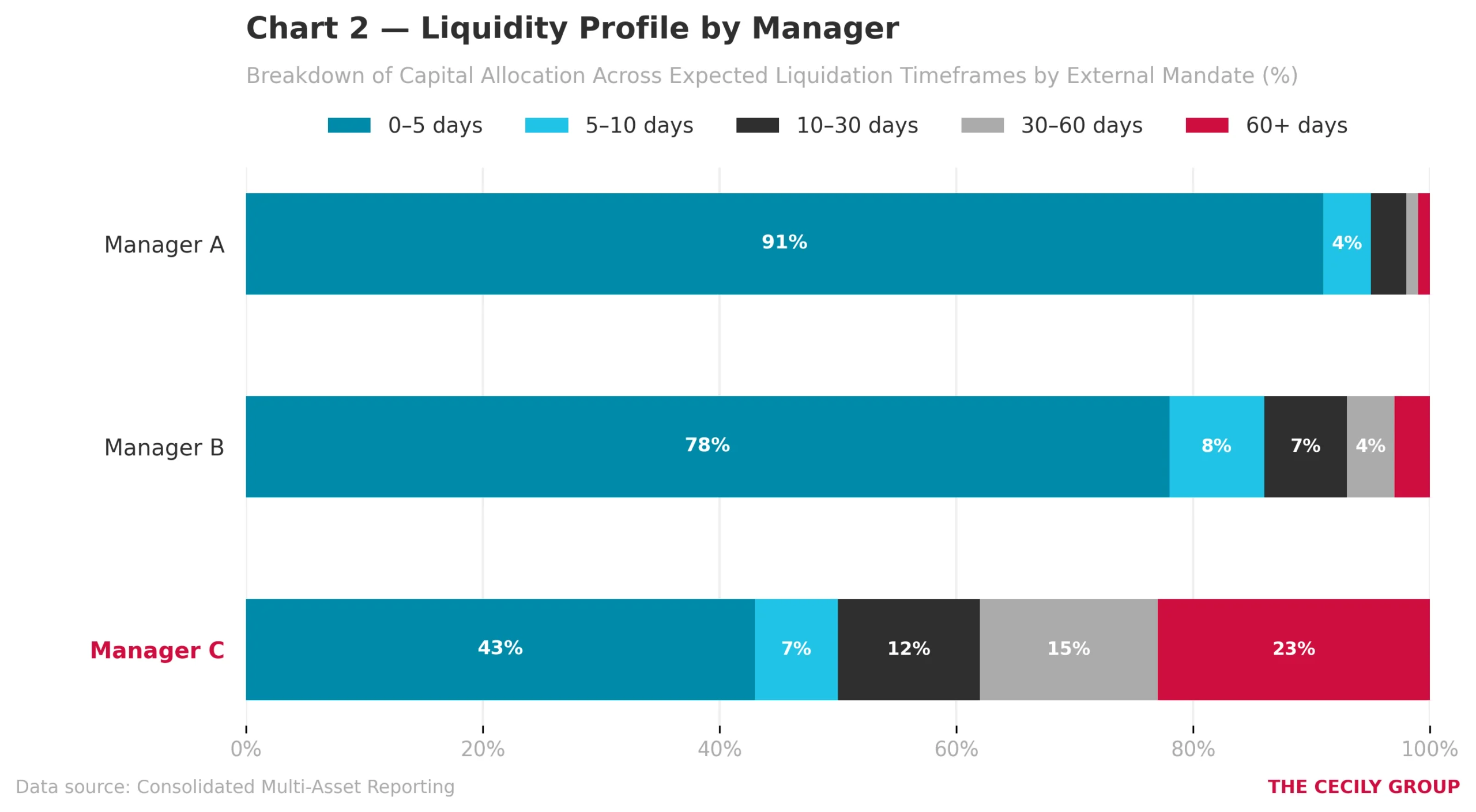
What it does: Breaks the consolidated liquidity profile down by external asset manager rather than relying on the aggregate portfolio figure.
Required inputs: Holdings and liquidity classifications for each manager mandate, together with the value of assets allocated to each manager.
What it reveals: Differences in the location of liquidity across managers. One mandate may consist predominantly of readily realisable assets while another contains a substantial allocation with longer redemption or realisation periods.
Why it matters: Highly liquid mandates can make consolidated portfolio liquidity appear stronger while significant constraints remain concentrated elsewhere. Manager-level analysis shows where those constraints sit and where closer oversight may be required.
Subtleties & Limitations
Manager percentages do not determine family liquidity needs. A manager can have a relatively illiquid portfolio without creating a liquidity problem if sufficient accessible capital exists elsewhere and the family’s expected cash requirements are known.
Aggregation across managers remains necessary. Manager-level analysis identifies concentrations, but the family’s ability to meet an obligation ultimately depends on liquidity across the consolidated portfolio.
3. IPS Allocation Bandwidth Analysis
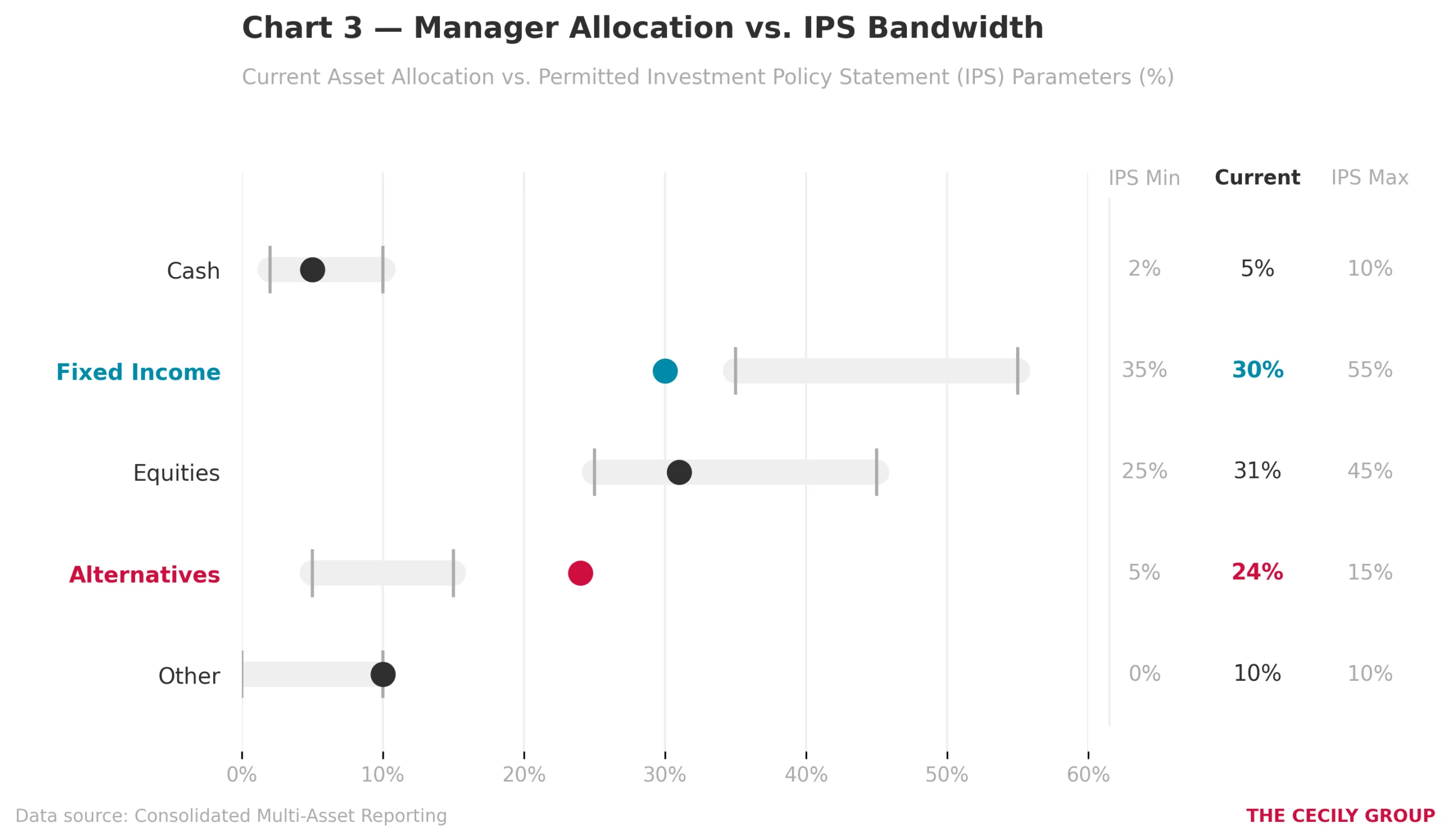
What it does: Compares each manager’s current asset allocation with the minimum and maximum ranges established in the Investment Policy Statement (IPS).
Required inputs: Current asset allocation by manager and the corresponding IPS allocation limits.
What it reveals: Whether liquidity constraints coincide with deviations from the agreed portfolio structure, such as an allocation moving above or below its permitted range.
Why it matters: Liquidity constraints become particularly relevant when they coincide with deviations from the agreed portfolio structure. A manager may have less flexibility to rebalance a mandate when a material share of its assets cannot be realised quickly.
Subtleties & Limitations
A mandate breach does not establish its cause. Current allocations can move outside policy ranges because of market movements, redemptions or other portfolio changes. The comparison identifies the deviation; it does not by itself explain how it developed.
Asset-class labels are an imperfect proxy for liquidity. Investments within the same broad asset class can have very different redemption terms. The liquidity-tier analysis is therefore still required to understand actual access to capital.
From Diagnosis to Action
A liquidity constraint does not automatically make an investment inappropriate. The governance issue is whether the family understands where capital is constrained, whether those constraints remain consistent with the investment mandate, and whether sufficient accessible capital is available when decisions need to be implemented.
Governance Implications
Manager accountability. Where a manager maintains substantial allocations in less-liquid investments, the committee needs more than an expectation that those positions will eventually mature. Redemption terms, expected realisation periods and exit conditions should form part of the oversight discussion.
Mandate discipline. Liquidity constraints become more consequential when they coincide with allocation limits. If less-liquid investments cannot readily be reduced, the manager may have less flexibility to restore the intended portfolio structure.
Decision capacity. Liquidity is relevant beyond meeting distributions or other cash requirements. It determines how readily the family can rebalance, change managers or respond to changing investment conditions. A portfolio can therefore have sufficient assets on paper while offering considerably less flexibility in practice.
Steps to Take
- Review liquidity against policy limits. Assess manager-level liquidity alongside the allocation ranges established in the Investment Policy Statement. Where a mandate is outside those ranges, require a clear plan and expected timeframe for returning to the agreed structure.
- Establish a formal liquidity schedule. Require managers to report redemption terms, notice periods and applicable restrictions for investments that cannot normally be realised within five days. This provides a clearer view of when capital is expected to become accessible.
- Test liquidity against actual cash requirements. Compare the portfolio’s liquidity tiers with expected capital calls, distributions, tax liabilities and other significant obligations. This helps determine whether available liquidity is sufficient for the family’s requirements rather than simply high in percentage terms.
- Challenge assumptions about realisable value. For material positions in the 60+ day category, distinguish reported valuations from the amount likely to be realised if capital were required earlier. Where appropriate, request evidence supporting assumptions about secondary-market liquidity and potential discounts.
- Review liquidity across managers. Assess liquidity at both consolidated and mandate level on a recurring basis. This prevents highly liquid managers from obscuring concentrations of constrained capital elsewhere in the portfolio.
Independent Reporting
The challenge is that each manager sees only part of the picture. They understand the redemption terms and liquidity characteristics within their own mandate, while principals and trustees need to understand how those constraints interact across the family’s total wealth and future capital requirements.
Independent reporting brings these individual views together, helping committees assess liquidity across managers and against the family’s agreed investment structure. For families that delegate substantial investment authority, independent oversight should be an essential part of effective governance.
Learn more about The Cecily Group’s independent financial reporting service.
Stay tuned as I continue unpacking our reporting methodology, and subscribe to our newsletter to follow the full Inside the Data series.
Reference
Samuelson, W. and Zeckhauser, R. (1988) ‘Status quo bias in decision making’, Journal of Risk and Uncertainty, 1(1), pp. 7–59. doi: 10.1007/BF00055564.