
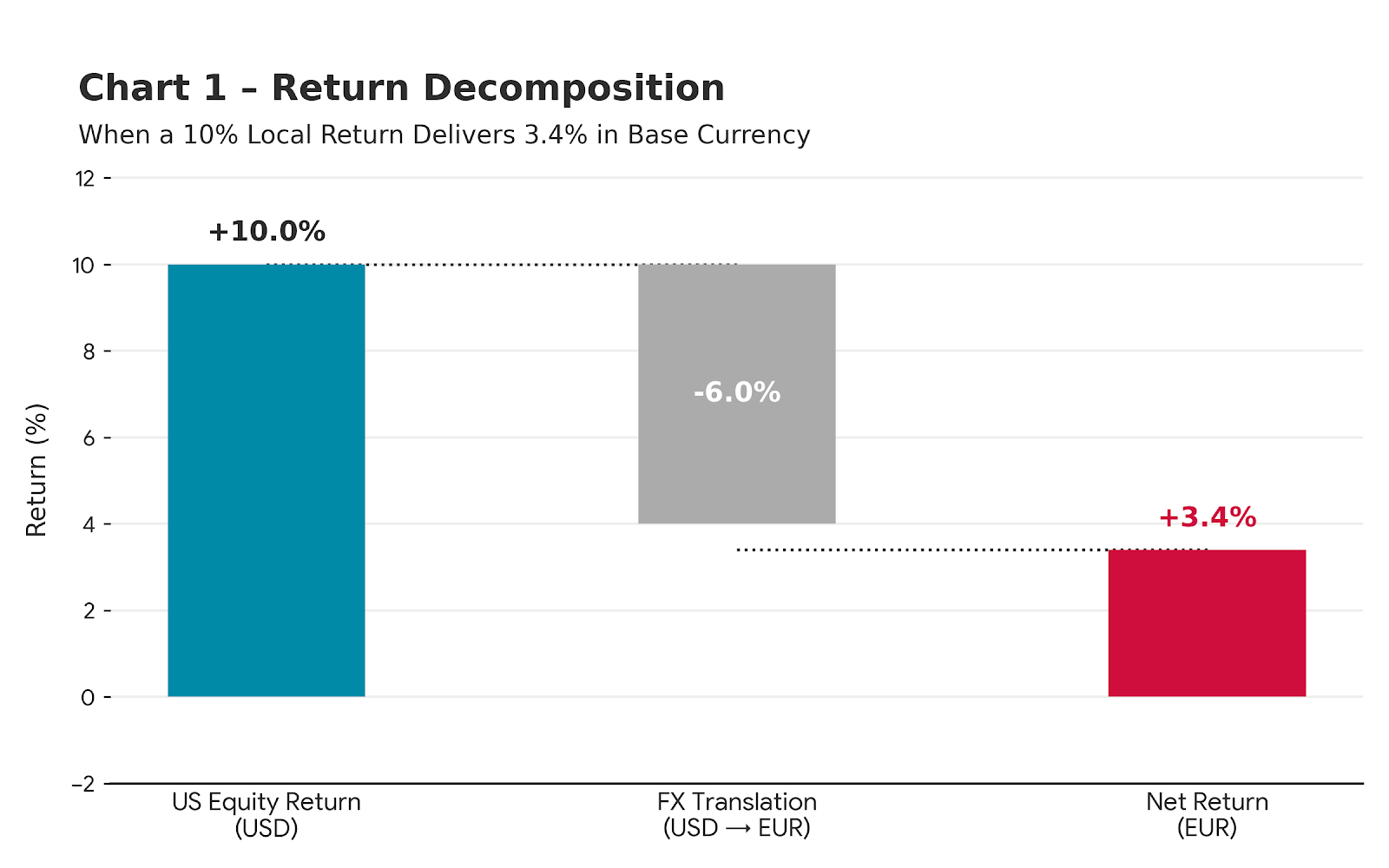
3.4%. A US equity position can rise by 10% in local currency terms, yet deliver only 3.4% to a European family when the US dollar falls by 6% against the euro. That difference is between reported investment success and realised purchasing power.
Standard manager reporting rarely exposes this clearly because the manager is usually assessed within the currency frame of the mandate, not the family’s base currency – the currency in which the family measures wealth, spending needs, tax obligations, and long-term purchasing power (CFA Institute, GIPS Glossary). The result is a reporting gap between portfolio performance and family-level economic validity.
The metric that often covers up this misalignment is the unhedged local asset return. It allows committees to read a manager’s fact sheet, compare headline returns, and assume the number reflects wealth creation. Yet it obscures whether performance stemmed from security selection, market exposure, or foreign-currency translation.
Independent reporting services are designed to consolidate portfolios across banks, managers, currencies, and benchmarks, with transaction-level analysis and independent attribution. This matters because what appears to be a single value can conceal hidden exposures, unreliable benchmarks, and risks that standard manager reporting leaves out of the governance discussion.
The Case Against Active Currency Oversight
Portfolio managers rarely ignore currency risk completely. More often, they argue that it either does not require active oversight or should be considered separately from investment performance. While these arguments contain elements of truth, they do not answer the governance question.
Defence 1: “Currency movements even out over time.”
Over very long periods, some exchange rates may move towards purchasing power parity. Families, however, do not invest in an abstract timeline. Tax payments, distributions, philanthropic commitments, business investments, and capital calls occur in specific years. A decade-long currency recovery offers little comfort if assets must be liquidated during an adverse exchange-rate cycle. Exchange-rate regimes can remain favourable or unfavourable for many years, creating prolonged periods in which currency movements materially influence realised returns (Lustig, Roussanov & Verdelhan, 2011).
Defence 2: “Hedging simply reduces returns.”
Currency hedging is not intended to maximise returns. It is a risk management decision. Whether a portfolio should be hedged depends on the purpose of the assets, the family’s future liabilities, and its tolerance for purchasing-power volatility. Institutional investors routinely distinguish between expected investment returns and unwanted currency risk because they represent different sources of uncertainty (Mercer, 2025; J.P. Morgan Private Bank, 2025).
Defence 3: “Our benchmark already reflects currency effects.”
A benchmark may accurately measure a manager’s mandate while still failing to measure the family’s wealth. Comparing a USD-denominated portfolio with a USD benchmark may confirm successful stock selection, yet reveal nothing about what ultimately happened after those returns were translated into the family’s reporting currency. Without return decomposition, committees cannot distinguish manager skill from currency translation (CFA Institute, 2020).
If reported performance combines investment decisions with exchange-rate movements, what exactly is the investment committee evaluating?
How Currency Exposure Accumulates
International diversification naturally introduces multiple currencies into a portfolio. The problem begins when those exposures accumulate without being measured at the total portfolio level. The process usually develops in four stages.
First, individual managers build portfolios within their own mandates. A US equity manager buys US securities. A private equity fund invests in North America. A global real estate allocation acquires assets in multiple jurisdictions. Each decision is reasonable when viewed in isolation.
Second, these exposures are consolidated only by asset class or manager. Reporting may show allocations to equities, fixed income, private equity, and real estate, yet fail to aggregate the underlying currency exposures across the entire enterprise. As a result, no one sees the family’s true foreign exchange position.
Third, investment performance is reported after currency translation, but the sources of return remain combined. A strong equity result may have been weakened by an appreciating home currency, while poor stock selection may have been concealed by favourable exchange-rate movements.
Only at this stage does the underlying governance issue become apparent: the portfolio has developed an (accidental) foreign exchange position. Currency exposure has become a portfolio-wide investment decision, despite never being discussed or formally approved by the board.
The consequences emerge when exchange rates move sharply and no overarching monitoring and, consequently, hedging is in place. A strengthening home currency simultaneously reduces the translated value of foreign equities, private market valuations, and overseas property holdings. Performance deteriorates across multiple asset classes even though the underlying investments may have performed exactly as intended.
The UBS Global Family Office Report 2026 found that many internationally invested families were reassessing their US dollar exposure, while 65% expected confidence in the dollar as the world’s reserve currency to weaken over the medium term (UBS Global Wealth Management, 2026).
Many family offices default to USD for historic reasons alone.
Liquidity Mismatch
Currency risk becomes particularly significant when portfolio assets and family obligations are denominated in different currencies.
A family may own predominantly US dollar assets while funding living expenses, taxes, philanthropic commitments, or private equity capital calls in euros or Swiss francs. If the domestic currency strengthens before those obligations fall due, purchasing power declines when liquidity is required. The family may be forced to liquidate high-quality investments to meet commitments that appeared fully funded only months earlier (Mercer, 2025).
Currency exposure, therefore, also influences the timing, cost, and flexibility of capital allocation.
Detecting Hidden FX Risk
Traditional performance reports answer a simple question: How much did the portfolio return? Independent reporting answers a different one: Why did it return that amount? The following analyses separate investment performance from currency effects.
Return Decomposition Analysis
What it does: Separates total portfolio return into local investment performance and foreign exchange translation.
Required inputs: Local asset returns, exchange-rate movements, benchmark returns, and the family’s base currency.
What it reveals: Whether reported performance was generated through manager skill or currency movements.
Why it matters: Investment committees can evaluate managers on factors they control rather than macroeconomic events they do not.
Subtleties & Limitations:
- Benchmark selection: Currency-adjusted benchmarks must align with the family’s reporting currency.
- Attribution consistency: All managers should apply the same decomposition methodology.
- Short-term volatility: Currency effects can dominate individual reporting periods without changing long-term investment quality.
An example of return decomposition was shown at the beginning of this article.
Currency Exposure Matrix
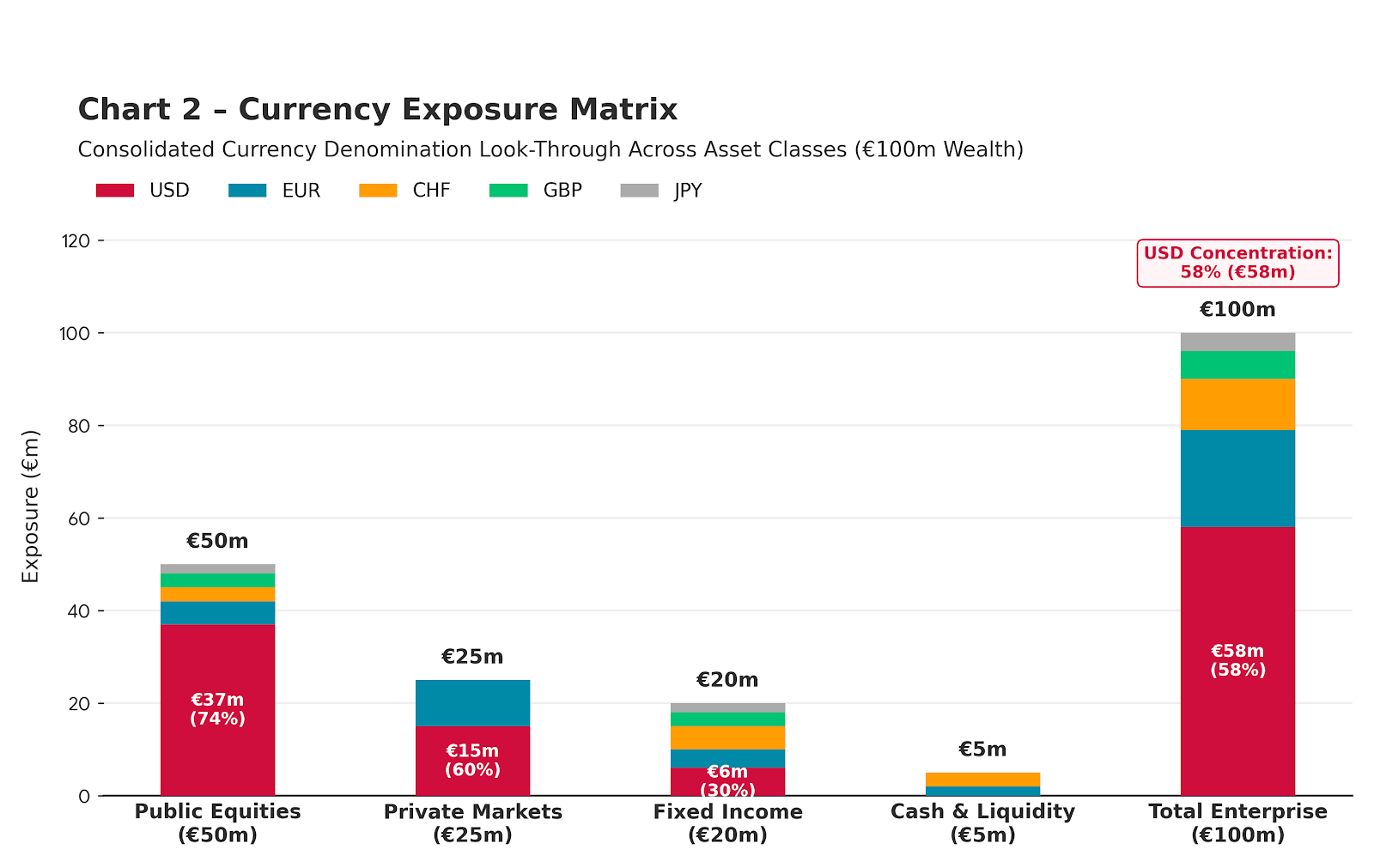
What it does: Consolidates every portfolio holding by its underlying currency denomination across all managers and asset classes.
Required inputs: Security-level holdings, fund look-through data where available, private asset valuations, and each asset’s reporting currency.
What it reveals: The family’s true net exposure to each currency, regardless of manager or legal structure.
Why it matters: Investment committees can identify unintended currency concentrations before they become portfolio-wide risks.
Subtleties & Limitations:
- Look-through quality: Private funds may disclose underlying exposures with a reporting delay.
- Listing versus economic exposure: A company’s listing currency may differ from the currencies in which it earns revenue.
- Valuation timing: Private market assets are often updated quarterly, creating temporary mismatches with liquid holdings.
Strategic Currency Allocation
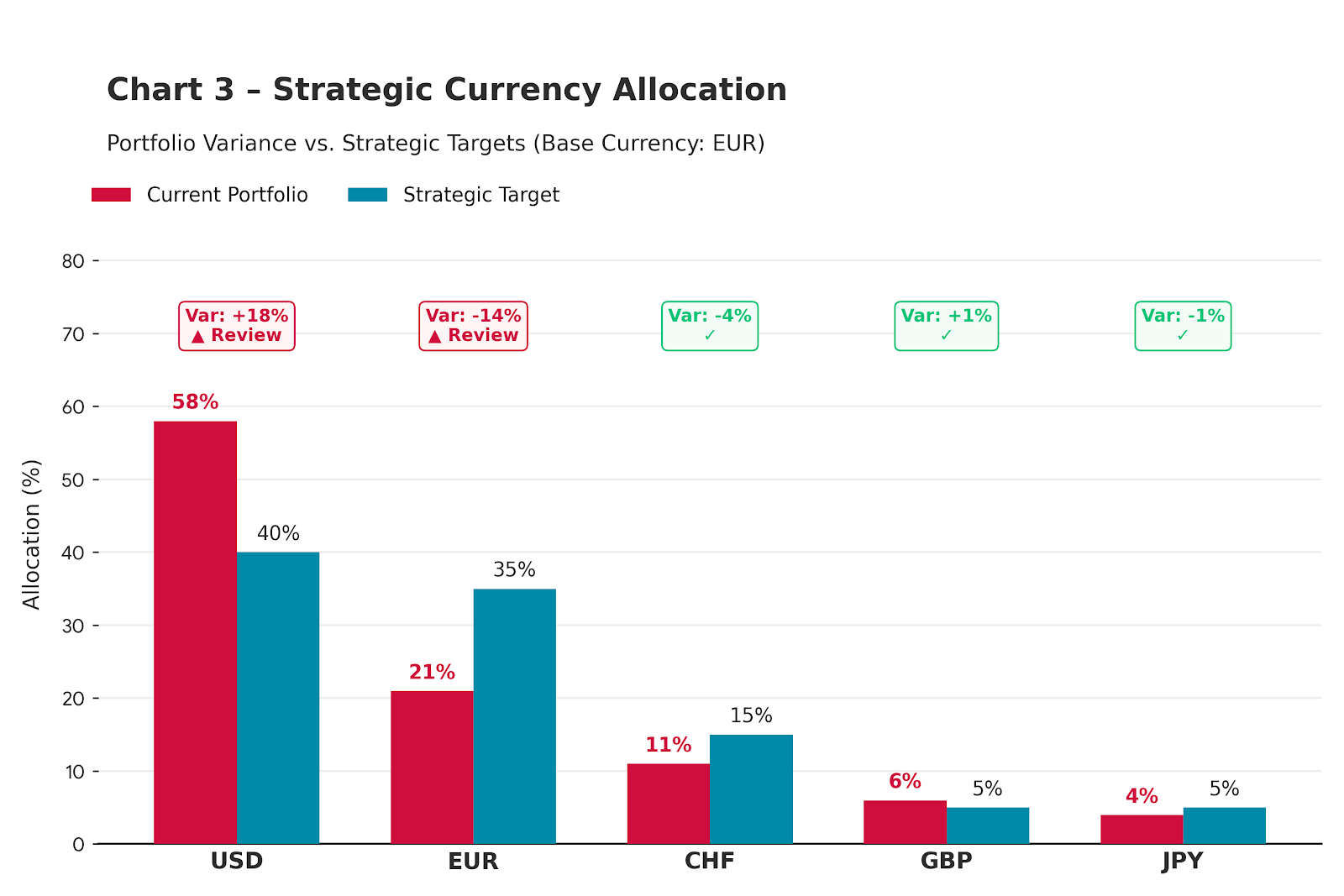
What it does: Compares actual currency exposures with board-approved strategic targets and tolerance ranges.
Required inputs: Currency exposure matrix, investment policy statement, approved allocation ranges, and any hedging positions.
What it reveals: Whether currency exposure reflects deliberate policy or gradual portfolio drift.
Why it matters: Currency becomes an independently governed risk factor rather than an unintended consequence of global investing.
Subtleties & Limitations:
- Policy quality: Strategic targets should reflect both investment objectives and future spending currencies.
- Natural hedges: Some foreign currency exposure may intentionally offset future liabilities.
- Implementation costs: Hedging programmes should be evaluated alongside their costs and operational complexity.
Currency Stress Testing
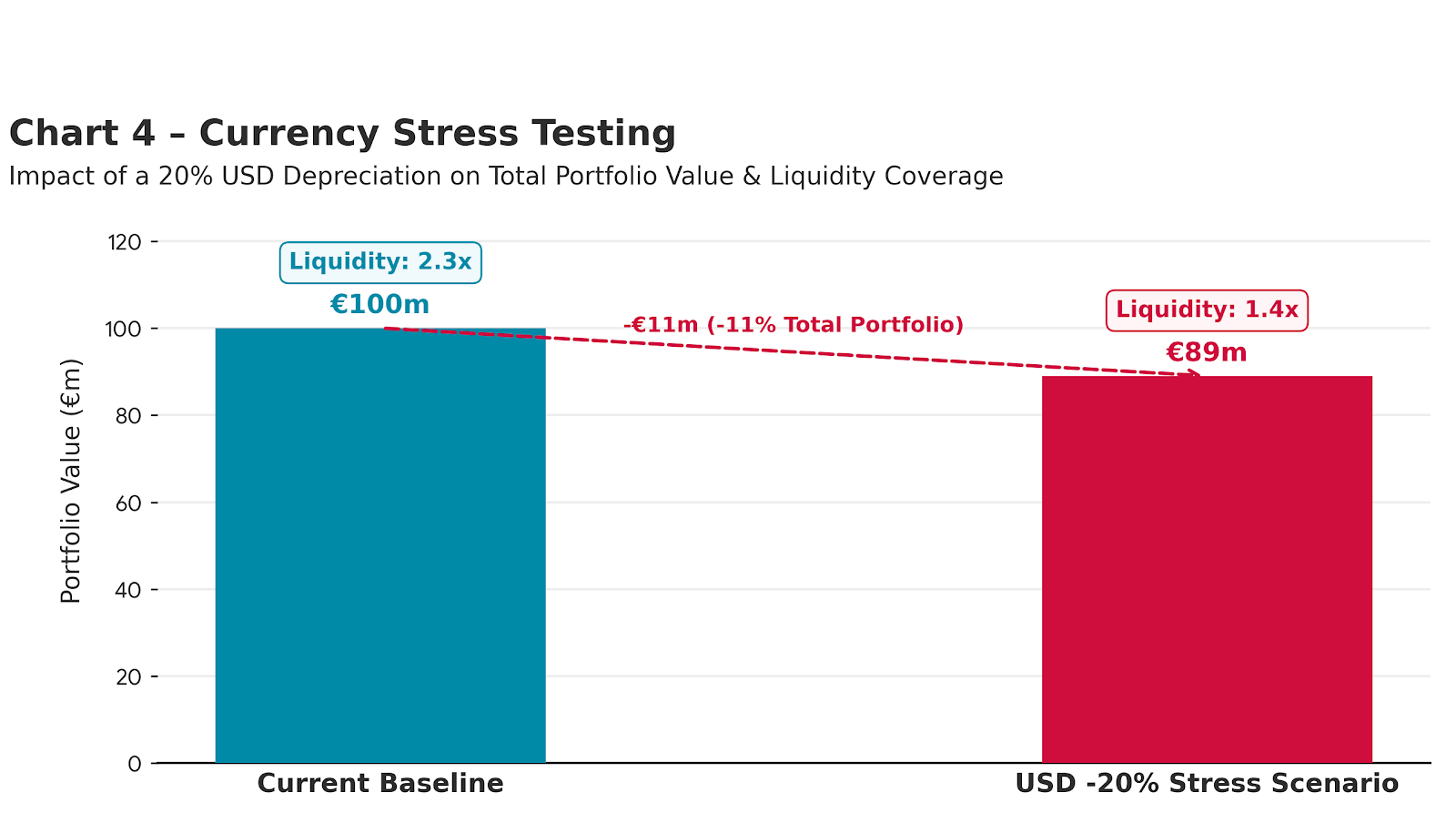
What it does: Models the impact of significant exchange-rate movements on total portfolio value and future liquidity.
Required inputs: Current currency exposures, liquidity forecasts, planned distributions, capital calls, and stress assumptions.
What it reveals: How adverse currency movements affect purchasing power and the family’s ability to meet future obligations.
Why it matters: Governance moves from explaining past outcomes to preparing for plausible future scenarios.
Subtleties & Limitations:
- Scenario assumptions: Results depend on the selected stress scenarios.
- Correlation effects: Currency movements often coincide with broader market volatility.
- Dynamic exposures: Currency allocations change continuously as markets move and portfolios evolve.
Together, these analyses provide a comprehensive view of how foreign exchange exposure influences portfolio performance and purchasing power. More importantly, they enable trustees and family councils to distinguish deliberate currency decisions from unintended portfolio drift before it becomes a governance issue.
Governing Multi-Currency Wealth
Governing multi-currency wealth begins with visibility. Families cannot make informed decisions about hedging, strategic allocation, or liquidity unless they understand how currency exposure develops across the entire portfolio and whether it reflects deliberate policy or unintended risk.
Currency is a governance decision. Once foreign exchange exposure reaches the portfolio level, it is no longer simply an implementation detail for individual managers. It becomes part of the family’s overall risk profile and should be reviewed with the same discipline as strategic asset allocation.
Performance attribution should separate skill from macroeconomic outcomes. A manager who outperforms in local currency may appear unsuccessful after adverse exchange-rate movements, while another may benefit from favourable currency trends despite weak security selection. Without independent attribution, boards risk rewarding and penalising outcomes for the wrong reasons.
Purchasing power is the true measure of wealth. Families ultimately consume, distribute, invest, and transfer wealth in their reporting currency. Governance therefore requires oversight of the factors that influence purchasing power, not simply the headline returns reported by underlying investment managers.
Steps to Take
- Build an enterprise-wide currency map.
Consolidate every liquid and illiquid investment into a single currency exposure report. The board should understand its total foreign exchange position across the entire portfolio, not manager by manager. - Require return decomposition in quarterly reporting.
Ask investment managers to report local asset performance separately from currency translation. This allows investment committees to evaluate manager skill independently of foreign exchange movements (CFA Institute, 2020). - Define a Strategic Currency Allocation.
Establish target currency ranges alongside the Strategic Asset Allocation. Currency exposure should have approved limits, review thresholds, and a documented governance process (Mercer, 2025; J.P. Morgan Private Bank, 2025). - Align currency exposure with future liabilities.
Compare portfolio currency allocations with expected spending, tax obligations, philanthropic commitments, and capital calls. Where appropriate, use natural hedges or targeted overlay strategies to reduce unnecessary mismatches. - Introduce currency stress testing into board reviews.
Assess how significant exchange-rate movements would affect portfolio value, liquidity, and purchasing power before those scenarios occur. Stress testing shifts governance from retrospective reporting to forward-looking oversight (Mercer, 2025).
Information asymmetry arises when investment managers understand the drivers of performance more clearly than the trustees, principals, or advisors responsible for oversight. Currency exposure widens this gap because exchange-rate effects are often embedded within reported returns rather than presented as a distinct source of risk.
Independent Reporting
Independent reporting separates investment performance from currency effects, allowing families to evaluate manager skill, understand their true purchasing power, and make informed decisions about strategic currency exposure. When currency becomes visible, it becomes governable.
Independent reporting creates a reporting premium by reducing information asymmetry. It protects decision quality by separating manager skill from macroeconomic forces, exposing unintended concentrations, and giving governing bodies the evidence needed to act before hidden risks become permanent losses.
Learn more about The Cecily Group’s independent financial reporting services: https://thececilygroup.com/financial-reporting/
Stay tuned as we continue unpacking our reporting methodology, and subscribe to our newsletter to follow the full Inside the Data series.
References:
CFA Institute (2020) Global Investment Performance Standards (GIPS®) 2020. Charlottesville, VA: CFA Institute. Available at: https://www.gipsstandards.org/wp-content/uploads/2021/03/2020_gips_standards_verifiers.pdf
Citi Private Bank (2025) Global Family Office Report 2025. New York: Citi Private Bank. Available at: https://www.privatebank.citibank.com/insights/the-family-office-survey
J.P. Morgan Private Bank (2025) An FX Hedging Framework for a More Divergent World. Available at: https://privatebank.jpmorgan.com/eur/en/insights/markets-and-investing/an-fx-hedging-framework-for-a-more-divergent-world
Hanno Lustig, Nikolai Roussanov and Adrien Verdelhan (2011) ‘Common Risk Factors in Currency Markets’, The Review of Financial Studies, 24(11), pp. 3731–3777. Available at: https://doi.org/10.1093/rfs/hhr068
Mercer (2025) Managing Currency Exposure in Family Office Portfolios: Strategic vs. Passive Approaches. Mercer Investments. Available at: https://www.mercer.com/insights/investments/portfolio-strategies/managing-currency-exposure-in-family-office-portfolios/
Reserve Bank of Australia (2024) Foreign Currency Exposure and Hedging in Institutional Portfolios. Sydney: Reserve Bank of Australia. Available at: https://www.rba.gov.au/publications/bulletin/2023/mar/foreign-currency-exposure-and-hedging-in-australia.html
Kenneth A. Froot (1993) ‘Currency Hedging over Long Horizons’, NBER Working Paper No. 4355. Available at: https://www.nber.org/papers/w4355
John Y. Campbell, Karine Serfaty-de Medeiros and Luis M. Viceira (2010) ‘Global Currency Hedging’, The Journal of Finance, 65(1), pp. 87–121. Available at: https://doi.org/10.1111/j.1540-6261.2009.01524.x
Visual: Olga Rozanova – Non-objective Composition