Two Mediterranean Dynasties, Two Paths to Permanence
A two-day, invitation-only family governance workshop built around real case studies and practical governance design.
October 2026 I Malta

Designing Family Governance in Action
Our sessions are designed as working discussions among a small group of participants.
Drawing on the Ferragamo family’s approach to ownership and leadership, alongside the contrasting legacies of Onassis and Niarchos, participants examine real governance decisions to understand:
- how governance tensions arise
- how structural choices influence long-term outcomes
- how comparable patterns arise across families with different structures and backgrounds
By the end of the session, participants have developed a clearer understanding of how different governance structures protect different priorities, and how those choices can be aligned with the family’s long-term purpose.

During the Workshop
Case Study I
The Ferragamo Family
Designing Governance After the Unexpected Death of Salvatore Ferragamo
Participants examine how the family redesigned ownership and leadership following the founder’s death. Working through the case, they consider questions such as:
- Should ownership remain equal or reflect contribution?
- Should ownership and leadership remain connected?
- How can family unity be preserved while maintaining effective decision-making?
- When should liquidity be prioritised over long-term control?
Case Study II
Onassis and Niarchos
Two Founders. Comparable Wealth. Different Governance Philosophies.
Participants compare two families that accumulated similar wealth but adopted fundamentally different approaches to succession and stewardship. The discussion explores:
- Which priorities each governance model was designed to protect
- The long-term consequences of each approach
- Which governance philosophy participants would choose for their own circumstances
Facilitators
The session is led by expert advisors working at the intersection of family governance, investment strategy, and institutional development.

Adrian Said
Economist and strategic advisor with more than 25 years of experience working with businesses, family offices, and public institutions across Europe and the UK.
Adrian specialises in growth strategy, capital raising, and institutional development, and has advised boards, investors, and sovereign entities on complex transformation and investment decisions.
His experience spans private and public sectors, including the development of international initiatives such as Trade Malta and the EMENA Sovereign Fund Network, as well as collaborations with organisations such as the Commonwealth Secretariat and the World Economic Forum.
He brings a macroeconomic and strategic perspective to questions of governance, continuity, and long-term value creation.
Dr. Nicholas Schwarz
Nicholas is the founder and CEO of The Cecily Group, a family governance consultancy with offices in Vienna. He works with ultra-high-net-worth families across Europe on governance design, reporting oversight, and the structural problems that sit between families and their advisors.
His doctoral research at SDA Bocconi examined how information asymmetries between family offices and external advisors shape trust and decision-making. The findings informed both a maturity model for family governance now being developed as a book and the Family Council Canvas, a platform that gives advisors and families a shared structure for governance conversations.
Learn more about The Cecily Group.
Follow Nicholas on LinkedIn.

A Governance Framework Anchored in Science
Family governance does not become difficult because families lack knowledge or experience. It becomes difficult when different assumptions about ownership, leadership, and stewardship have never been made explicit.
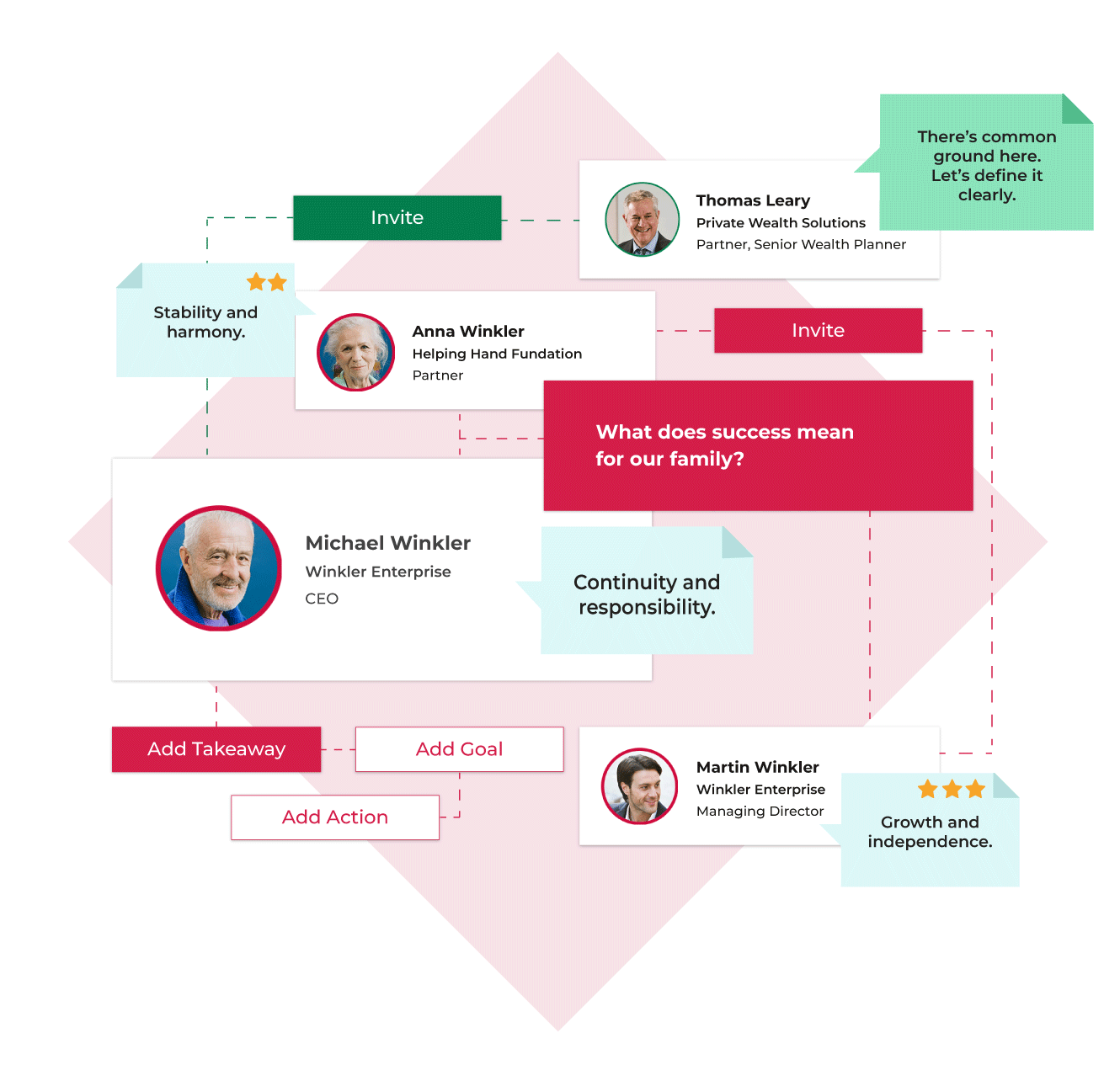
The Family Council Canvas was developed by Dr Nicholas Schwarz and his team at The Cecily Group to help families make implicit assumptions visible.
Nicholas’s doctoral research examined how differences in knowledge, expectations, and communication influence governance outcomes. Combined with more than two decades of advisory work, this research led to a practical framework that helps families surface assumptions, articulate priorities, and support more deliberate governance decisions.
What Participants Take Away
- A clearer view of how governance tensions form and evolve
- A structured approach to analysing complex family decisions
- Greater awareness of how assumptions shape outcomes
- Insight into how other families approach similar challenges
- The opportunity to test your thinking in a focused peer setting
Request to Join
This workshop is held in a small-group format to allow for depth of discussion and exchange. Attendance is limited.
If you would like to take part, please let us know by completing the form below or contacting us directly at nicholas@thececilygroup.com.