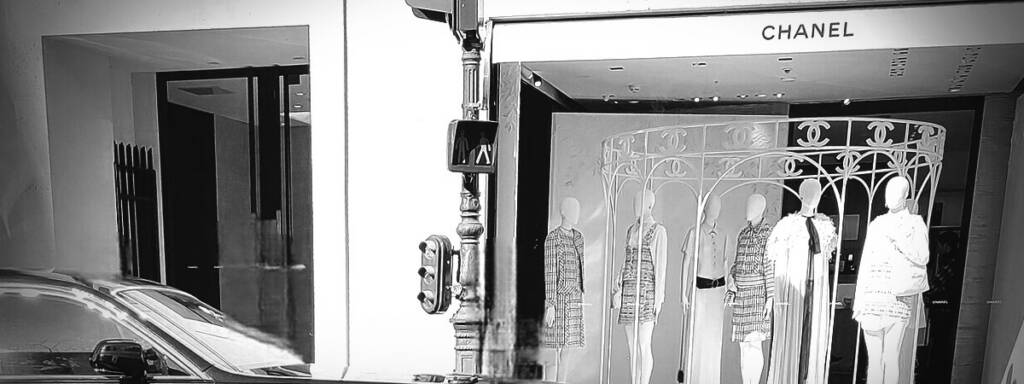
Remi Mathis – Rolls & Chanel, Paris
For most of the world, Chanel begins and ends with Gabrielle “Coco” Chanel — the rebellious designer, the pearls, the perfume, the mythology. But Chanel the legend and Chanel the institution are not the same story.
Behind the couture house stands a family that survived Nazi expropriation, reconciled with a collaborator, and built one of the most formidable private family offices in the world — all while refusing a public listing and consistently declining the spotlight.
For more than a century, the Wertheimers have controlled the capital, the governance, and ultimately the direction of the brand. They did not sketch the silhouettes. They engineered the structure that allowed the house to endure.
This is not a tale of flamboyant heirs in a public family saga. It is a study in restraint — in theatrical rouge before couture, in industrial manufacturing before luxury mythology, and in an escape from war that laid the foundations for one of the most enduring private dynasties in modern business history.
Bourjois, Alsace, and the Design Behind the Icon
Long before No. 5 became one of the world’s most recognisable fragrances, the Wertheimer fortune began in cosmetics manufacturing. In 1870, Ernest Wertheimer left Alsace for Paris following the upheaval of the Franco-Prussian War. That migration — driven by geopolitical instability — established a pattern that would repeat across generations: mobility, pragmatism, and cross-border positioning as tools of survival.
In 1898, Ernest acquired an interest in Bourjois, a cosmetics firm known for its theatrical dry rouge, developed specifically for actors performing under unforgiving stage lighting. Unlike couture, this was a business built on laboratory precision, formula consistency, and scalable production. Under Wertheimer ownership, Bourjois strengthened its laboratories, expanded manufacturing capacity, and built structured distribution networks.
By the early 1900s, Ernest’s sons, Paul and Pierre Wertheimer, had expanded the business internationally. Paul moved to New York, while Pierre established operations in London. Manufacturing scaled in Rochester, New York, supplying not only Bourjois but also other cosmetics brands of the era.
Decades before luxury conglomerates existed, the Wertheimers had already developed:
- International manufacturing capability
- Cross-Atlantic distribution
- Industrial expertise in fragrance chemistry
- Access to global retail channels
This infrastructure would later make the global expansion of Chanel No. 5 possible.
The 1924 Formation of Parfums Chanel
When Gabrielle Chanel launched Chanel No. 5 in 1922, it was initially sold only to clients of her Paris boutique. The scent carried prestige, and its promotion was remarkably modern for its time: Chanel introduced it during private gatherings among her elite clientele and ensured that her showrooms were consistently infused with the fragrance. It was an exclusive product with strong brand symbolism, but it lacked the operational scale required for global reach.
Transforming a couture fragrance into an international commodity required capital, production facilities, distribution networks, and structured marketing. Chanel possessed creative authority and brand magnetism; the Wertheimers possessed industrial infrastructure and financial capacity.
In 1924, Parfums Chanel was formed under a formal ownership agreement:
- 70% to the Wertheimer brothers
- 20% to Théophile Bader, founder of Galeries Lafayette
- 10% to Gabrielle Chanel
The Wertheimers assumed financial and operational risk. Chanel licensed her name and retained creative influence. From a capital-allocation perspective, the structure was commercially rational for a manufacturing and distribution-heavy expansion.
Yet as Chanel No. 5 became a global success, Gabrielle Chanel grew increasingly dissatisfied with her minority stake. For family office advisors, this early chapter offers a crucial lesson: incentive alignment at the founding stage determines the emotional stability of a partnership over time. As the brand expanded internationally and profits multiplied, the ownership proportions remained fixed. What may have felt equitable at inception became emotionally imbalanced as value creation accelerated. The agreement aligned capital risk with reward, but it did not sufficiently align creative contribution with upside over time. Embedding mechanisms for performance-based participation or periodic recalibration might have reduced the friction that later hardened into litigation.
Legal challenges followed in the late 1920s and intensified through the 1930s. What had begun as a scaling partnership gradually evolved into a governance conflict between creative talent and capital control. Then history intervened. The Second World War transformed a shareholder disagreement into an existential threat.
Survival, Proxy Control, and the Limits of Ownership
As a Jewish family, the Wertheimers were directly targeted by the Nazi policy of “Aryanisation”, which mandated the seizure of Jewish-owned businesses across occupied Europe
In May 1940, anticipating the fall of Paris, Pierre and Paul Wertheimer fled to New York. Before leaving, they executed a decisive legal manoeuvre: control of Parfums Chanel was transferred to Félix Amiot, a non-Jewish French industrialist. Amiot agreed to hold the company in trust for the duration of the war.
This proxy strategy shielded the business from confiscation. On paper, the company no longer appeared Jewish-owned. In practice, it remained under the strategic protection of the family. From exile in the United States, the Wertheimers re-established operations and ensured that the fragrance business continued internationally
Production knowledge, formulas, and supply chains were protected. The brand survived thanks to legal foresight and cross-border positioning — patterns already visible in the family’s earlier history.
Gabrielle Chanel’s Wartime Involvement
While the Wertheimers were in New York, Gabrielle Chanel remained in Paris. During the occupation, she attempted to use the Aryanisation laws to reclaim control of Parfums Chanel by arguing that the business had been “abandoned” by its Jewish owners.
Her effort failed: the Amiot structure held. The transfer occurred just before the fall of Paris, reducing the window in which authorities could intervene before documentation was updated. Legally, there was nothing left for her to seize. Amiot appeared as the legitimate owner under French law. He was also economically useful to the German administration as an aviation industrialist. There was little incentive to disrupt a functioning company already under acceptable ownership.
The wartime chapter is uncomfortable but instructive. It demonstrates that ownership, particularly in times of political upheaval, is only as secure as the legal architecture surrounding it. It also reveals how rapidly a creative partnership can fracture when legal leverage becomes available.
For family enterprises, this period illustrates three governance realities:
- Political risk must be anticipated before a crisis emerges.
- Cross-border diversification is not merely strategic expansion; it is protection.
- Legal structure can preserve value when personal relationships collapse.
The Wertheimers’ foresight turned a potentially catastrophic expropriation into a temporary custodianship. For governance observers, this shows how pre-emptive restructuring can render even hostile legal environments ineffective — provided it is executed early enough and with credible counterparties.
By the end of the war, Parfums Chanel had survived. The question was whether its fractured relationships could be repaired.
Reconciliation as Strategic Governance
After the liberation of Paris, Gabrielle Chanel was briefly arrested under suspicion of being a Nazi collaborator and later moved to Switzerland. The Wertheimers, having regained effective control of the business, faced a pivotal governance decision. They could marginalise the founder or sever the association entirely.
Instead, Pierre Wertheimer chose negotiation. In 1954, a settlement was reached. Chanel received:
- A substantial cash payment for past profits
- A 2% royalty on global perfume sales
- Financial support for the relaunch of her couture house
In exchange, the Wertheimer family consolidated full ownership of the company. This decision was neither sentimental nor forgiving. It was strategic. The brand’s long-term value remained tied to the living presence of Gabrielle Chanel. Restoring her to fashion restored legitimacy to the house itself.
For family office advisors, this moment represents an unusual form of governance maturity: the ability to subordinate personal grievance to institutional continuity. The Wertheimers prioritised the brand’s name and long-term capital preservation over moral retaliation. The war had tested their legal architecture. The reconciliation tested their strategic discipline. With ownership consolidated and the founder reinstated, the stage was set for a different challenge: generational transition within the family itself.
The Post-War Era
After the Second World War, Christian Dior’s 1947 “New Look” redefined women’s fashion, favouring structured silhouettes and dramatic femininity. In contrast, Chanel’s earlier aesthetic — streamlined, practical, and emancipated — temporarily appeared restrained. During the late 1940s and early 1950s, the house’s influence within high fashion faded, but it did not disappear.
Chanel No. 5 remained commercially powerful and culturally resonant. Its mythology deepened through figures such as Marilyn Monroe, whose remark about wearing “only a few drops of No. 5” reinforced the fragrance’s aura of sensual sophistication.
At the same time, Jacqueline Kennedy became closely associated with the Chanel suit — the wool bouclé, collarless jacket with contrasting trim that had become a defining symbol of modern bourgeois elegance. The pink suit she wore in Dallas on 22 November 1963 became tragically iconic after the assassination of President John F. Kennedy. Her decision to remain in the blood-stained suit during the swearing-in of Lyndon B. Johnson engraved the garment into collective memory.
Fragrance provided financial continuity. Couture and ready-to-wear moved through cycles of visibility and reinterpretation. By the time Jacques Wertheimer assumed leadership, Chanel possessed immense heritage capital, yet required strategic renewal to fully reassert fashion dominance.
The Second Generation
When Pierre Wertheimer died in 1965, leadership passed to his son, Jacques Wertheimer. Jacques did not attempt radical reinvention. He preserved private ownership, maintained structural continuity, and avoided public spectacle. The house remained intact, financially stable, and under family control. That restraint proved decisive. It allowed the third generation to later intervene from a place of stability — most notably through the appointment of Karl Lagerfeld in 1983.
Expansion and Institutionalisation
The transition to Alain and Gérard Wertheimer marked a shift from preservation to controlled expansion. By the early 1980s, Chanel remained financially strong through fragrance and accessories, yet its fashion division lacked contemporary relevance. After Gabrielle Chanel’s death in 1971, the house continued producing collections, but without the cultural authority it once commanded.
Chanel herself had never married and had no biological children. She played a devoted maternal role in the life of her nephew, André Palasse — the son of her late sister Julia-Berthe — and supported him throughout his life. Palasse later worked within the organisation in a limited capacity, but he neither inherited ownership nor assumed strategic leadership.
This absence of a direct heir carried structural consequences. While the founder’s name defined the brand, her lineage did not anchor its governance. When she died in 1971, control didn’t pass through a creative bloodline; it remained entirely with the Wertheimer family.
For Alain and Gérard Wertheimer, this clarity of ownership created both responsibility and opportunity. The house carried immense heritage capital, but heritage alone would not secure renewed cultural authority. The brand required reinvention.
Karl Lagerfeld was not an obvious conservative choice. By 1983, he was already a prolific designer, working simultaneously for Fendi and his own label. He had a reputation for speed, theatricality, and intellectual sharpness. Chanel, by contrast, was associated with restraint and bourgeois refinement. Precisely this tension made him attractive. The Wertheimers needed someone who understood fashion history, was unafraid of provocation, and could decode Chanel’s symbols without imitating them.
Lagerfeld famously remarked that when he joined, many considered Chanel “a sleeping beauty” and that he had been brought in to wake it. Importantly, he did not approach the archive reverently, but with analytical distance.
He identified Chanel’s core codes, such as the interlocking C logo, camellias, chains, quilted handbags and the tension between masculine tailoring and feminine line to create continuity through trusted motives. Rather than replicate Gabrielle Chanel’s silhouettes, he exaggerated and reinterpreted these elements. He shortened skirts, amplified shoulders, layered costume jewellery, and elevated the double-C into a bold visual signature.
He once stated that he did not believe in nostalgia. He understood that Coco Chanel herself had been radical in her time; therefore, true loyalty to her legacy required ongoing reinvention.
This philosophy aligned with the Wertheimers’ governance approach:
- Preserve ownership
- Protect structure
- Allow creative evolution
Lagerfeld respected the founder myth but did not treat it as sacred doctrine. He transformed Chanel from a respected heritage house into a dominant global fashion force. By the 1990s and 2000s, the brand had regained cultural supremacy. Under his tenure, Chanel became a multi-billion-dollar powerhouse
From a family governance perspective, the 1983 decision reveals something essential: the separation between capital ownership and creative leadership reduced succession risk. The family controlled the structure and strategy. Creative reinvention remained professionalised. Lagerfeld’s 36-year tenure (until his death in 2019) demonstrates the success of this model.
For family offices advising operating families, this moment offers a clear insight: long-term continuity often depends on knowing which roles should remain family-held and which should not.
Alain Wertheimer supported Lagerfeld by building the industrial infrastructure of a global fashion empire. Under his leadership, the company expanded internationally and strengthened vertical integration. Chanel acquired specialist workshops and craftsmanship houses to protect supply chains and preserve technical expertise. Rather than outsourcing heritage, they internalised it.
Importantly, throughout this expansion, Chanel remained privately held. Competitors such as LVMH and Kering operated under public-market scrutiny. Chanel did not. Private ownership allowed:
- Long-term creative appointments
- Significant reinvestment during downturns
- Minimal disclosure obligations
- Absolute discretion around family affairs
Over time, remaining private despite the scale of the business became a defining governance principle.
Mousse Partners
While Chanel expanded operationally, the family’s wealth strategy evolved structurally. In 1991, Charles Heilbronn founded Mousse Partners, the family office serving the Wertheimer dynasty. Over time, it developed into a globally diversified investment platform managing tens of billions of dollars.
Mousse Partners operates as the investment arm of Mousse Investments, the Cayman-based holding structure that ultimately controls Chanel. Its portfolio extends beyond fashion into private equity, real estate, venture capital, and credit.
This institutionalisation of wealth served several purposes:
- It diversified risk beyond the cyclical luxury market.
- It professionalised capital allocation.
- It created a training ground for future generations.
The family didn’t want to rely solely on the operating company to sustain its fortune. They built a parallel capital engine.
Corporate Restructuring
In 2018, Chanel centralised its corporate structure under a London-based parent company, Chanel Limited. The move simplified governance, internationalised the board, and aligned the company with a more favourable dividend environment.
Substantial dividends were distributed to the family’s holding entity in subsequent years. Yet even during periods of revenue contraction — including a 4.3% revenue decline in 2024 — Chanel significantly increased capital expenditure.
The company invested while others retrenched. This capacity to act counter-cyclically reflects the advantage of private governance. Without quarterly earnings pressure, strategic patience becomes operationally viable.
If the first generation built the infrastructure and survived war, and the second protected continuity, the third reimagined the brand for modern luxury markets.
The Fourth Generation
As Alain and Gérard Wertheimer move into their seventies, succession planning moves into focus. Arthur Heilbronn, a member of the fourth generation, represents a notable example of structured preparation. Educated at Harvard Business School and trained at Goldman Sachs, he joined Mousse Partners after years of external experience. His role centres on private equity and capital allocation rather than fashion design.
The next generation is being positioned to govern capital, not to replace creative directors. Operational leadership remains professionalised, with external executives such as Leena Nair guiding the company’s global management.
The emerging model resembles a hub-and-spoke system:
- Core capital governance centralised within the family office
- Operational management entrusted to professional executives
- Select heirs pursuing independent ventures
From theatrical rouge in 19th-century Paris to a global luxury empire managed through institutional capital structures, the Wertheimer saga reads as a success story of structured continuity — despite friction and external upheaval.
The Four Abundances
Viewed through the lens of the Four Abundances, the Chanel–Wertheimer case reveals more than financial success. It shows how different forms of capital are protected, balanced, and transmitted across generations.
1. Wealth
Financially, Chanel remains one of the largest privately held luxury companies in the world. In 2024, revenues reached $18.7 billion despite a 4.3% decline in a challenging macroeconomic environment. Operating profit decreased significantly, yet capital expenditure increased by 43% to a record level. This pattern reflects a clear philosophy: downturns are investment windows.
Because the company is privately owned, it can prioritise long-term positioning over short-term earnings optics. Boutique expansion, craftsmanship preservation, and brand investment continue even when margins compress.
Beyond the operating business, Mousse Partners provides diversification across private equity, real estate, and other asset classes. This separation between operating risk and financial capital reduces dependency on fashion cycles and stabilises family wealth. Wealth, in this structure, is treated as institutional capital.
2. Relationships
The relational history of Chanel is complex. The early partnership with Gabrielle Chanel created deep resentment. Litigation spanned years. Wartime politics intensified fractures. Yet in 1954, the Wertheimers chose reconciliation over retaliation. That decision restored institutional coherence. It demonstrated an ability to distinguish between personal grievance and brand continuity.
Internally, the family adopted a different relational strategy: discretion combined with clarity. The Wertheimers rarely appear publicly, and they do not position themselves as creative figureheads. Visibility is carefully limited. This reduces personality-driven tension and shields family dynamics from external amplification.
Equally important is the gradual preparation of successors and the clear separation of governance roles. The emerging fourth generation is being integrated primarily through the family office rather than through symbolic positions within the fashion house. Operational leadership remains professionalised. Creative direction remains external.
This separation supports relationships in two ways: internally, it reduces ambiguity around authority. Family members are prepared methodically for capital stewardship rather than competing for symbolic control of the brand. Externally, it reassures executives, designers, and partners that operational decisions are guided by competence and brand continuity.
Gradual preparation stabilises expectations. Clearly defined governance roles reduce rivalry. Professional management preserves credibility. In this structure, relationships are supported through clarity of mandate, boundaries of influence, and disciplined discretion.
3. Time
Few family enterprises maintain uninterrupted control over a global brand for 100 years. Chanel has. The family’s refusal to list the company publicly is central to this temporal orientation. Public markets compress time; private governance extends it.
The appointment of Karl Lagerfeld in 1983 and the long duration of his tenure reflect a patient approach. The recent appointment of Matthieu Blazy signals another long-cycle creative investment. Even corporate restructuring — such as the 2018 London pivot — was executed with succession preparation in mind. The family does not appear to optimise for quarters or even decades. The operating logic resembles generational planning.
4. Purpose
Perhaps the most distinctive abundance in this case is purpose. The Wertheimers do not publicly embody the brand’s creative identity. They do not attempt to replace the founder myth with a family narrative. Instead, they position themselves as custodians of a house that predates them and is meant to outlive them.
Vertical integration of artisanal workshops reflects a commitment to preserving craft. Continued investment during downturns reflects confidence in continuity. Purpose, in this context, is about institutional stewardship.
Across these four dimensions, a pattern emerges: restraint combined with structural foresight.
Now let’s explore: if a family office were advising this dynasty at critical junctures — 1924, 1940, 1954, or the present fourth-generation transition — how might structured governance tools have clarified tensions earlier or reduced risk further?
How the Family Council Canvas Could Have Helped
The Wertheimers built their governance architecture gradually, often under pressure. Much of what they implemented — proxy ownership, diversification, professionalised succession — emerged as a response to crisis or transition rather than through a formalised family framework.
A structured tool, such as the Family Council Canvas, would not have changed external events. It could, however, have clarified alignment and reduced friction at pivotal moments.
1. Incentive Clarity Before Conflict
At the formation of Parfums Chanel, the ownership distribution was financially logical but emotionally fragile. A structured governance conversation could have addressed:
- What recognition and influence did Gabrielle Chanel expect over time?
- Under what conditions would equity be revisited?
- How would creative contribution be valued relative to capital risk?
The conflict that later escalated into litigation was rooted in perceived imbalance. A Canvas-style mapping of wealth, purpose, and relational expectations might have surfaced those tensions early.
2. Managing Founder Relationships
Once litigation began, positions hardened. A formalised governance forum — distinct from courtroom proceedings — could have created space for renegotiation without public escalation. The Canvas framework could have supported:
- Scenario modelling of brand impact under prolonged dispute
- Assessment of reputational risk
- Mediation structures between the founder and capital owners
Instead, the relationship deteriorated until wartime dynamics overtook it.
3. Formal Risk Mapping
The Amiot proxy structure was a masterful example of legal foresight, yet it appears to have been executed under urgent geopolitical pressure. The transfer was arranged in the narrow window before the fall of Paris, when timing was critical and uncertainty acute.
The positive outcome depended on swift judgment and decisive action. It worked because the right decision was made at the right moment. From a governance perspective, this raises a difficult question: what if the founder at that time had misjudged the counterparty, delayed action, or underestimated the risk? In crisis conditions, concentration of authority in a single individual amplifies both speed and vulnerability. The margin for error becomes existential.
A structured family governance process might have addressed such exposure earlier through:
- Political risk assessment in concentrated jurisdictions
- Pre-defined contingency planning for asset seizure
- Pre-agreed cross-border ownership protocols
- Clear delegation frameworks for emergency decisions
The family acted decisively and successfully. Yet the episode also illustrates how much responsibility rested on individual instinct under extreme pressure. Institutionalising risk frameworks in advance reduces the burden on a single decision-maker and transforms survival from personal judgement into structural preparedness.
4. Brand vs Emotion
The post-war settlement required prioritising institutional value over personal grievance. A structured governance discussion could have clarified:
- What portion of brand equity depended on founder mythology?
- What were the financial implications of exclusion versus reintegration?
- How would long-term ownership be consolidated?
The Wertheimers ultimately chose strategically. A formal framework could have accelerated that clarity and reduced uncertainty.
5. Role Definition and Capital Stewardship
Today’s transition is far more structured than earlier phases. Yet even now, a Canvas approach would help articulate:
- Who governs capital versus who governs operations
- Whether family members are expected to join the operating company or the family office
- How independent ventures fit into collective wealth strategy
- What purpose does the next generation attach to the brand
Clear articulation of roles prevents ambiguity. Ambiguity is often the silent trigger of generational conflict.
The Wertheimer story shows that instinct, discretion, and discipline can produce exceptional outcomes. But it also illustrates how many turning points hinged on implicit assumptions rather than explicit alignment. It may be that structure doesn’t replace judgment, but it can very well support it.
What the Case Teaches Family Offices
The Chanel–Wertheimer case offers several valuable lessons for family offices advising multigenerational wealth holders:
- Private control enables temporal freedom.
Remaining privately held allowed Chanel to invest through downturns and avoid market-driven governance distortions. - Legal foresight is strategic capital.
The Amiot proxy arrangement demonstrates how ownership architecture can neutralise hostile political environments. - Reconciliation can be economically rational.
The 1954 settlement preserved brand mythology and consolidated control. - Professionalising heirs protects scale.
Arthur Heilbronn’s external training and structured entry into Mousse Partners illustrate deliberate preparation. - Diversification supports value creation.
Separating operating risk from investment capital through Mousse Partners stabilises long-term wealth and enables the family to invest in legacy. - Discretion can be a governance strategy.
The family’s absence from public spectacle limits internal pressure and preserves autonomy.
Closing Words
The Chanel brand is built on aesthetic codes: tweed, camellias, and interlocking Cs. The Wertheimer legacy is built on structural codes: private control, legal architecture, capital discipline, and generational preparation.
For family offices seeking to preserve wealth across centuries, the lesson is neither glamour nor scale. It is institutionally reinforced governance designed to outlast personal greatness — or grievances.
Disclaimer: This article is a case study based on publicly available information and is intended for educational and informational purposes only. The analysis and opinions expressed are those of the author and do not constitute factual claims about the private lives or intentions of the individuals discussed. Images and excerpts from third-party sources are included solely for purposes of commentary and criticism, with attribution provided where sources are known.
References:
Hels (2021). The Most Brilliant Business Family in France. [online] Art and Architecture, mainly. Available at: http://melbourneblogger.blogspot.com/2021/11/the-most-brilliant-business-family-in.html [Accessed 18 Feb 2026].
Kafkaesque Blog (2014). The Wertheimer Brothers and Coco Chanel. [online] Available at: https://kafkaesqueblog.com/tag/wertheimer-chanel/ [Accessed 18 Feb 2026].
Orzyla (2025). Arthur Heilbronn: The Next Generation of Wertheimer. [online] Available at: https://www.orzyla.com/en/chanel-arthur-heilbronn-the-next-generation-of-wertheimer/ [Accessed 18 Feb 2026].
Patel, T. and Stupples, B. (2025). Chanel Owners Lean on 38-Year-Old to Protect Their Billions. Luxuo. [online] Available at: https://www.luxuo.com/business/chanel-owners-lean-on-38-year-old-to-protect-their-billions.html [Accessed 18 Feb 2026].
Vaughan, H. (2011). Sleeping with the Enemy: Coco Chanel’s Secret War. New York: Alfred A. Knopf..
Wikipedia (2025). Mousse Partners. [online] Available at: https://en.wikipedia.org/wiki/Mousse_Partners [Accessed 18 Feb 2026].
Crefovi (2021). How Chanel kissed goodbye to France. [online] Available at: https://crefovi.com/articles/fashion-law/how-chanel-kissed-goodbye-to-france/ [Accessed 18 Feb 2026].
Chanel Limited (2025). CHANEL LIMITED FINANCIAL RESULTS FOR THE YEAR ENDED 31 DECEMBER 2024. [online] Available at: https://www.chanel.com/puls-img/1747810519727-20250520fy24resultspressreleasefinalwwpdf.pdf [Accessed 18 Feb 2026].