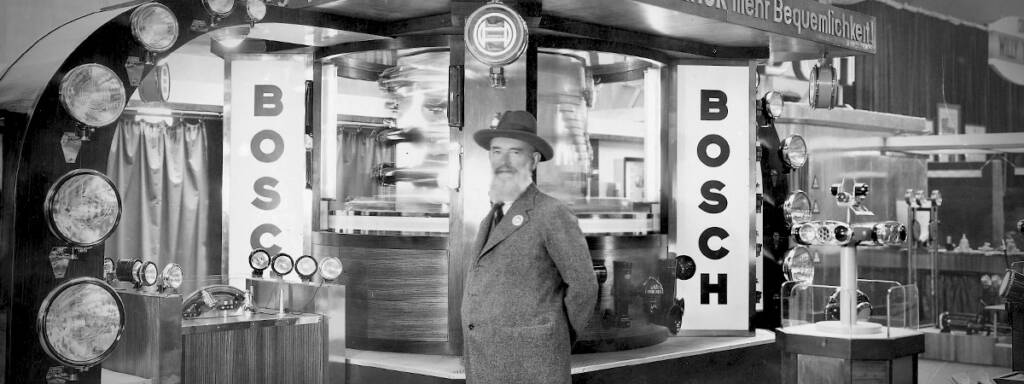
Robert Bosch in front of the Bosch stand at the Berlin Motor Show, 1931
The choice between family and legacy is one of the most painful challenges a family owner can face. When Robert Bosch began preparing his succession, he had to confront the possibility that securing his dynasty and bloodline might not be viable. Still, he was determined to protect his legacy from the forces that could unravel it: family conflict, political extremism, market pressure and time itself.
Today, Robert Bosch GmbH generates more than €90 billion in annual revenue. It invests billions into artificial intelligence and hydrogen. It operates globally. Yet it is neither publicly listed nor controlled by descendants in the traditional sense.
Bosch experienced the collapse of biological succession. He faced ideological conflict within his own household and totalitarian political pressure, but rather than tighten family control, he gradually redesigned the family’s role within power. The result is a governance architecture of unusual sophistication.
For family offices, the Bosch case raises an intriguing question: What if the safest way to preserve a family legacy is to ensure that no single family member controls it?
In the sections that follow, we trace how personal tragedy led to institutional innovation, how voting power was separated from wealth, and how a structure built nearly a century ago continues to finance long-term industrial strategy today.
Values Before Structure
Long before governance became legal architecture, it was personal conviction. Robert Bosch was born in 1861 in Albeck, near Ulm, the eleventh of twelve children. His father, Servatius Bosch, was a well-educated innkeeper with liberal and democratic leanings. A freemason, he believed in civic responsibility, intellectual development, and fairness. Business, in his view, existed to serve society.
Bosch trained as a precision mechanic and, following the custom of the time, travelled as a journeyman. In 1884, he worked at Edison Machine Works in the United States. He later gained experience with Siemens Brothers in Britain. These encounters exposed him to something transformative: the idea that industrial scale requires organisational sophistication and superior quality.
During his training, Bosch encountered a different standard of measurement, repeatability and technical scrutiny. His later statement reflects this influence:
“I was always plagued by fears that someone would check my products and prove that I had made something of inferior quality. That is why I have always sought to only release work that has passed all objective tests, in other words, that is crème-de-la-crème.”
(Robert Bosch, 1918, Principles)
The insistence on “objective tests” suggests a deep internalisation of industrial discipline. Excellence had to be demonstrable and withstand inspection.
When he returned to Stuttgart in 1886 and opened his “Workshop for Precision Mechanics and Electrical Engineering”, he was 25 years old and operating with a single apprentice. The early years were precarious. He installed telephone systems and electric bells while searching for a breakthrough.
It arrived in 1887 with the low-voltage magneto ignition, followed by the high-voltage magneto in 1902. That invention made high-performance internal combustion engines viable and propelled the company into global expansion.
The magneto positioned Bosch at the centre of the emerging automotive industry. As motor vehicles scaled across Europe and the United States, reliable ignition systems became indispensable. Bosch became a supplier of functional necessity.
From there, the company expanded into fuel injection systems, starter motors, lighting systems and diesel technology. Over time, its portfolio widened to include industrial technology, power tools, household appliances and automation systems.
What distinguished Bosch was not product diversity alone, but consistency of engineering standards. The insistence on objective testing that characterised the early workshop became institutionalised across product lines. Industrial growth, therefore, did not dilute the founder’s quality standards.
Bosch, like his father, also believed in education, fairness and public responsibility. But growth introduced a new tension. How does a founder preserve values when the enterprise outgrows his direct supervision?
Social Reform as Corporate Identity
In 1906, Bosch introduced the 8-hour workday — radical for its time. He invested heavily in employee welfare and education. He funded schools and social initiatives. Employees called him “Father Bosch”, reflecting a paternalistic but respected leadership style.
By the early 1910s, the company had grown far beyond the founder’s workshop, and international expansion was underway. Industrial scale demanded coordination, discipline and hierarchy. Bosch’s two guiding principles were now operating simultaneously:
- A civic belief that industry should serve society.
- A craftsman’s insistence on objective standards and central authority.
For a time, these aligned. Higher wages, reduced working hours and welfare measures supported both social fairness and productivity.
But 1913 exposed a fracture. When workers at the Stuttgart plant went on strike, Bosch did not see himself as an unjust employer. He believed he had already acted progressively. From his perspective, he had met reasonable standards of fairness.
His daughters, Paula and Margarethe, disagreed and sided with the workers. They were responding to a broader shift in labour politics across Europe that moved beyond paternalistic reform toward collective bargaining and organised power.
The Collapse of the Intended Heir
The strike and his daughters’ involvement in it were an especially hard blow for Bosch because, by this time, his son and natural successor, Robert Bosch Jr. ( 1891–1921), was stripped of the capacity to lead due to his multiple sclerosis. He died in 1921 at the age of thirty, but years before his death, it had already become clear that he could not assume control.
For Bosch, who believed in building a business for social good and improving conditions through responsible leadership, the whole situation must have been destabilising. He had tried to set objective standards for fairness, but those standards were now being challenged.
And if disagreement could arise over labour policy while he was still alive and in control, what would happen after his death? The strike revealed the fragility of assuming alignment within the family.
Bosch also had to deal with managerial anxiety about continuity. For senior executives such as Gottlob Honold and Gustav Klein, the situation was alarming. If control passed purely through inheritance, the company could become vulnerable to conflicting priorities.
Bosch faced a sobering convergence: his civic inheritance required continuity of social purpose, and his technical discipline required continuity of excellence. His family could not guarantee either. For a man unwilling to release inferior products, an inferior succession plan was not acceptable.
The Public Limited Company Without the Public
In 1917, Bosch converted the firm into a stock corporation with the main purpose of formalising an associate partnership. He granted 49% of shares to trusted executives. He retained 51% — yet arranged trusteeship so that professional managers would effectively hold majority influence if he became incapacitated.
For family offices, this marks the birth of what might be called a “synthetic founder” mechanism: when a biological heir is uncertain, authority is redistributed to a professional coalition that embodies the founder’s standards.
In 1921, the year his son died, Bosch established Vermögensverwaltung Bosch GmbH (VVB), an estate management vehicle.
Profits from his holdings were to alleviate hardship and promote health and education. The capital would serve society, and the heirs would be provided for, while being protected from fragmentation.
This separation removed one of the most common sources of intergenerational tension: the conflation of dividend rights with decision-making authority.
Governance as Defence
Yet circumstances forced him to revise his plans once again. The rise of the National Socialist regime introduced existential risk, not only to Germany’s political order, but to independent industrial governance. Bosch, a committed democrat, held deep reservations about the regime. In 1937, he converted the stock corporation back into a private limited company (GmbH). The move reduced regulatory exposure and shielded internal governance from political interference. It allowed the company to limit external oversight at a time when board composition could be manipulated by the state.
The Foundation–Trust Compromise
In 1938, Robert Bosch finalised his will, a constitutional document with three defining mandates:
- Preserve the company’s financial independence.
- Maintain ties with descendants.
- Direct profits towards the public good.
After his death in 1942, it took more than two decades to fully implement the model. The resolution created a structure still in place today:
- The Robert Bosch Stiftung became the primary economic owner.
- Voting rights were transferred to the Robert Bosch Industrietreuhand KG (RBIT), an industrial trust.
- The family retained a minority stake and representation.
Today, Robert Bosch GmbH operates under a governance structure that deliberately separates economic benefit from strategic authority. The ownership architecture is unusual in the global industry, but the division creates a built-in balance of power.
The Foundation benefits economically but does not direct operations. The Industrial Trust exercises entrepreneurial oversight but does not extract wealth for private consumption. The family remains connected but cannot unilaterally control the enterprise. It is a constitutional system, not a dynastic one.
The industrial trust functions as a permanent steward. It appoints and oversees management, safeguards long-term strategy and ensures adherence to the founder’s principles. In effect, it performs the role that a committed owner-founder might have exercised, without requiring concentrated family control. This institutionalised “synthetic founder” allows voting power to remain concentrated and decisive while preventing fragmentation across generations.
Stewardship Without Operational Control
A visible representative of the family today is Christof Bosch, grandson of the founder and Chairman of the Board of Trustees of the Robert Bosch Stiftung since 2017.
Christof is the son of Robert Bosch Jr II. (1928–2004), who was born from the founder’s second marriage. When Robert Bosch began redesigning the company’s governance structure in 1917 and formalised it further in the early 1920s, his second son had not yet been born. By the time Robert Jr II. reached adulthood, operational leadership had already been firmly placed in professional hands.
Robert Bosch Jr. II. studied electrical engineering in Stuttgart and later served as a member of the supervisory board of Robert Bosch GmbH from 1971 to 1978. Together with his sister Eva Madelung, he held approximately 8% of the company’s share capital. However, he did not assume executive leadership of the operating company.
The Bosch model, therefore, did not evolve into a dynastic line of chief executives. Instead, it preserved a family presence within ownership and supervisory structures while entrusting operational leadership to professional managers.
Christof Bosch followed a different path. Trained as a forester, he manages agricultural and forestry interests and represents the family within foundation governance rather than corporate management. Under his chairmanship, the Robert Bosch Stiftung has strengthened its emphasis on sustainability, public health and education, reinterpreting the founder’s civic commitments for the present era.
The Power of Not Being Listed
Because Bosch is not publicly listed, it is insulated from quarterly earnings pressure and activist investor campaigns. This insulation is a direct consequence of the governance design. The company has committed:
- €2.5 billion to artificial intelligence by 2027.
- €5 billion to hydrogen technologies by 2030.
- Multi-billion-euro acquisitions in the United States.
- Long-term investment in electromobility.
Such investments require patience and tolerance for cyclical downturns. In more volatile fiscal years, management can prioritise restructuring and long-term positioning without the destabilising pressure of public market sentiment.
This structural autonomy is particularly significant in periods of technological transition. Bosch’s historical strength lay in combustion-engine technology: fuel injection systems, diesel components and automotive electronics. Yet the global shift toward electrification and decarbonisation challenges precisely those legacy advantages.
Instead of defending the past, the company has invested heavily in electromobility, battery systems, advanced driver assistance technologies and hydrogen fuel cell systems. It has also committed billions to artificial intelligence applications across manufacturing, consumer appliances and industrial automation.
The governance structure supports this reinvention. Because the company is shielded from short-term shareholder pressure, it can manage the decline of combustion-related revenue while financing the technologies that may replace it. It can absorb restructuring costs without triggering activist intervention.
Bosch can think in decades because its ownership structure was built to outlive individual stakeholders. Most companies design their strategy within ownership constraints. Bosch designed ownership to serve strategy.
The Four Abundances
From the beginning, Bosch embodied two enduring commitments:
- social responsibility as a civic duty, and
- technical excellence as a non-negotiable standard.
Today, the governance structure carries both forward without forcing one to subordinate the other.
Wealth
Robert Bosch GmbH generates more than €90 billion in annual revenue. It invests heavily in forward-leaning technological bets. Large-scale investment in AI, manufacturing innovation, and industrial systems adheres to the high technical standards Bosch set for the company.
At the same time, the majority of economic returns flow to the Robert Bosch Stiftung, funding public health, education, international understanding and sustainability initiatives. This continues the civic mandate inherited from Servatius Bosch.
The structure aligns technological ambition with social purpose. One legacy feeds the other.
Relationships
The separation of voting rights from dividend rights removed one of the most destabilising forces in multi-generational enterprises: the struggle between family members and professional management. Family members are not forced into operational roles, and professional managers are not subordinated to dynastic expectations. The Foundation is not driven by quarterly extraction. Relationships are stable because the power structures are clear and sensible.
Time
Bosch began reshaping governance roughly 25 years before his death. He moved from sole proprietorship to AG, from AG to GmbH, and from family control toward institutional trusteeship. He didn’t wait for a crisis to force urgency.
Today, the company’s ability to pursue long-horizon strategies — from artificial intelligence to hydrogen — reflects this temporal insulation. It can absorb cyclical downturns and restructuring without strategic panic.
Time is perhaps the most underestimated asset in family enterprise, one that is secured through institutional structure.
Purpose
Robert Bosch’s 1938 will mandated that profits promote public welfare. This principle is therefore structurally embedded through the Robert Bosch Stiftung. Because the Foundation is the primary economic owner:
- The company’s success directly funds health, education and social initiatives.
- Public benefit is aligned with corporate performance.
- Purpose cannot easily be abandoned for private extraction.
This creates a reinforcing loop: commercial success strengthens social mission, while social mission legitimises commercial autonomy.
Many families attempt to protect these four forms of abundance through informal agreements or family councils alone.
Bosch shows that one way wealth, relationships, time and purpose can outlive the founder is by being embedded into governance. Robert engineered alignment structurally, so he didn’t have to rely on personal willingness.
How the Canvas Could Have Helped
The Bosch succession was thoughtful, but it was also reactive to tragedy, conflict and political upheaval. A structured framework such as the Family Council Canvas would not have changed history, but it could have made certain tensions explicit earlier, and less painfully. Let us revisit the critical inflection points.
The 1913 Labour Conflict
When Bosch’s daughters sided with striking workers, the disagreement exposed:
- Diverging interpretations of fairness.
- Generational differences in political ideology.
- A lack of clarity about the family’s role in governance.
A Canvas conversation at that stage could have surfaced:
- What is the family’s shared definition of social responsibility?
- Where does operational authority end and moral oversight begin?
- Are heirs expected to support management decisions publicly?
Rather than framing the episode as personal betrayal, it might have been understood as governance misalignment.
The Illness of Robert Bosch Jr.
When it became clear that his son could not assume leadership, Bosch responded structurally. But this realisation emerged gradually. A Canvas framework could have formalised earlier discussion around:
- Capability versus entitlement.
- Alternative leadership pathways.
- The role of professional management.
- The difference between ownership and executive authority.
Many families avoid this conversation until a crisis forces it. Bosch ultimately addressed it, but not before anxiety spread among senior executives.
Professional Management Anxiety
Executives such as Gottlob Honold and Gustav Klein were concerned about continuity. A Canvas exercise could have mapped:
- Expectations of professional managers.
- Safeguards against destabilising inheritance.
- Governance structures that reassure non-family leadership.
Professionalisation requires clear communication between internal and external stakeholders.
The 1964 Foundation–Trust Compromise
The eventual compromise — transferring economic ownership to the Foundation while consolidating voting power in the Industrial Trust — required trade-offs:
- The family relinquished majority control.
- The Foundation renounced voting rights.
- The Trust assumed long-term stewardship responsibility.
A structured mapping of:
- Wealth (who benefits economically),
- Relationships (who remains connected),
- Time (how long the structure must function),
- Purpose (what must never be diluted),
would have made those trade-offs more transparent. In many family systems, these negotiations become emotional, but clarity reduces anxiety and helps make family members involved in critical decisions.
Strategy 2030 and Beyond
Today, Bosch invests heavily in both sustainable and cutting-edge technologies. These decisions reflect both industrial strategy and a reinterpretation of the founder’s ideals.
A Canvas lens can ensure that:
- New technologies align with the foundational purpose.
- Sustainability is integrated rather than symbolic.
- Long-term capital allocation remains mission-consistent.
The Canvas does not impose answers, but it helps to define key questions.
What the Case Teaches Family Offices
For family offices advising multi-generational capital, the case offers several durable lessons.
Separate Wealth from Power
One of the most destabilising forces in family enterprise is the assumption that economic ownership must automatically confer control. Bosch broke that equation.
By allocating:
- Dividends to the Foundation,
- Voting rights to the Industrial Trust,
- Minority participation to the family,
The structure reduced the likelihood that control battles would follow inheritance patterns.
For family offices, the question becomes: Are dividend rights and voting authority intentionally aligned — or merely inherited together?
Where those two are fused, conflict risk rises exponentially.
Institutionalise the Founder
Many founders embody clarity, decisiveness and long-term orientation. The difficulty arises when those qualities depend on a single personality.
Bosch translated founder authority into governance architecture.
The Robert Bosch Industrietreuhand KG functions as a permanent steward, exercising concentrated voting control without requiring concentrated family ownership.
For families without a capable or willing heir, the alternative to fragmentation is not abdication. It is institutionalisation.
Who, or what, becomes the guardian of the founder’s standards?
Start Before Crisis Forces You
Bosch began restructuring roughly 25 years before his death. He moved from sole proprietorship to stock corporation, from stock corporation back to private company, and from inheritance logic toward trust-based stewardship.
Family offices often see succession planning postponed because control feels secure. The Bosch case suggests the opposite approach: redesign governance while authority is still undisputed.
Clarity is easier to implement before vulnerability appears.
Use Philanthropy as a Structural Anchor
The Robert Bosch Stiftung is not peripheral. It is the primary economic owner.
This alignment ensures:
- Corporate success funds public benefit.
- Public legitimacy reinforces corporate autonomy.
- Purpose is not dependent on marketing narratives.
Philanthropy, in this case, is not distribution. It is architecture.
For families seeking longevity, anchoring ownership to mission may create stronger cohesion than anchoring it solely to wealth.
Design for Time, Not for Emotion
Bosch faced family disagreement, labour unrest, executive anxiety and political authoritarianism. Each time, he responded with a structural adjustment.
Family enterprises frequently attempt to resolve tension through personal negotiation. That may work for the short term, but it rarely scales beyond one generation. Bosch designed a structure that would guide the company long after his direct involvement ended. Personal discussions could never have provided that long-term clarity.
Accept That Values Will Be Reinterpreted
Today, the company invests in contemporary technological inventions that are not literal extensions of magneto ignition. They are, however, expressions of industrial responsibility. The founder’s civic ideal — that industry should serve society — is being translated into 21st-century language. Longevity requires adaptability and creativity, so the essence of legacy can outlive the times it was created in.
Closing Words
Beyond factories, product lines, and a brand name, Robert Bosch’s most ingenious design was his governance model.
He confronted the collapse of biological succession and didn’t respond with desperation. He experienced ideological disagreement within his own household and didn’t respondwith exclusion. He faced authoritarian pressure and didn’t respond with an authoritarian voice or by folding under pressure. He responded to those challenges by creating constitutional systems that reflected long-term strategic foresight.
For family offices advising families across generations, this poses the question: should succession be treated as inheritance or as design? If legacy depends solely on lineage, it is fragile. If it is embedded into ownership itself, it may outlast the founder entirely.
Disclaimer: This article is a case study based on publicly available information and is intended for educational and informational purposes only. The analysis and opinions expressed are those of the author and do not constitute factual claims about the private lives or intentions of the individuals discussed. Images and excerpts from third-party sources are included solely for purposes of commentary and criticism, with attribution provided where sources are known.
References:
Bähr, J. (2022). Between values orientation and economic logic: Bosch in the Third Reich. [online] Routledge. Available at: https://www.taylorfrancis.com/chapters/edit/10.4324/9781003321040-5/values-orientation-economic-logic-bosch-third-reich-johannes-bähr [Accessed 19 Feb 2026].
Hartung, S. (2025). AI that gets things moving. [online] Robert Bosch GmbH. Available at: https://www.bosch.com/stories/tech-day-ai/ [Accessed 19 Feb 2026].
Porters Five Force (2025). Who owns Robert Bosch GmbH? Strategy and Governance. [online] Available at: https://portersfiveforce.com/blogs/owners/bosch [Accessed 19 Feb 2026].
Robert Bosch GmbH (2025). History Blog: Resistance to Hitler — the Bosch Circle. [online] Available at: https://www.bosch.com/stories/resistance-to-hitler-bosch-circle/ [Accessed 19 Feb 2026].
Robert Bosch GmbH (2025). The transformation of Bosch’s legal form over the years. [online] Available at: https://www.bosch.com/stories/history-bosch-legal-form/ [Accessed 19 Feb 2026].
Robert Bosch GmbH (2026). Dr. Christof Bosch: “Sustainability is of existential importance”. [online] Available at: https://www.bosch.com/stories/christof-bosch/ [Accessed 19 Feb 2026].
Robert Bosch GmbH (n.d.). Robert Bosch: Life and work. [online] Available at:(https://assets.bosch.com/media/global/bosch_group/our_history/publications_ordering/pdf_2/Robert_Bosch_Life_and_work.pdf) [Accessed 19 Feb 2026].
Robert Bosch Stiftung (2024). The Bosch Constitution. [online] Available at: https://www.bosch-stiftung.de/en/who-we-are [Accessed 19 Feb 2026].