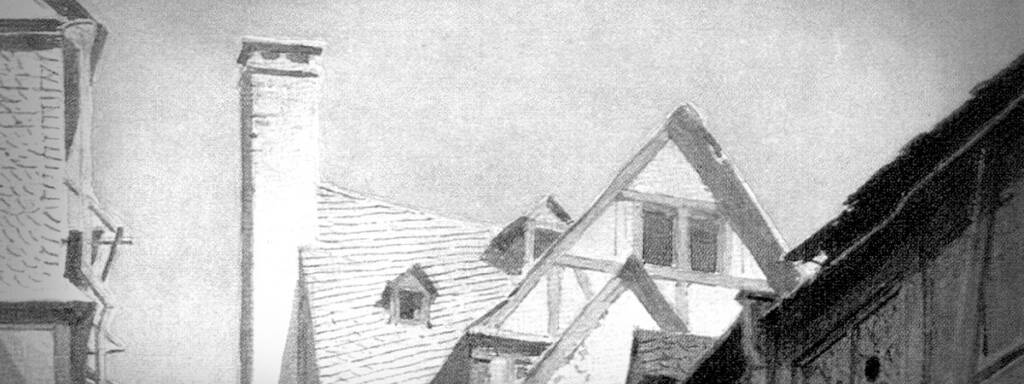
Carl Theodor Reiffenstein – Judengasse
The Rothschild family is often portrayed through the mythology of extraordinary financial talent, yet their true achievement lies elsewhere: in the deliberate construction of structures that preserve unity, authority, and continuity across more than two centuries. What began as a fragile partnership operating from a Jewish ghetto in Frankfurt evolved into one of the most enduring financial enterprises in modern history.
The Rothschild succession is the story of a dynasty repeatedly refining its governance to match shifting political, financial and social environments. It shows how families adjust their governance systems over time, clarify their centre, and protect the space needed for long-horizon decisions.
From the Judengasse to Europe’s First Cross-Border Banking Network
Mayer Amschel’s most transformative decision was to disperse his five sons across Europe’s major financial capitals — Frankfurt, Vienna, London, Naples and Paris — creating the first truly international banking network. It allowed the brothers to move information and capital faster than states, support governments during wars and political turbulence, and extend the family’s influence beyond any single jurisdiction.
A central figure in this expansion was the third son, Nathan Mayer Rothschild, who established N M Rothschild & Sons in London. His success in securing the contract to fund the Duke of Wellington’s army during the Napoleonic campaign marked a decisive step in the family’s ascent. It demonstrated that the network could operate effectively even during periods of geopolitical upheaval and positioned the London house as a dominant financial institution.
In recognition of their growing importance, the five brothers were made Barons of the Austrian Empire in 1822. The imperial ennoblement formalised the family’s standing among Europe’s elites and granted symbolic weight to the structure Mayer Amschel had created.
Their coat of arms, quartered with a fist holding five arrows, represented the unity of the five houses. The motto “Concordia, Integritas, Industria” (unity, integrity, industry), granted by the Austro-Hungarian Emperor, encapsulated the qualities that underpinned the family’s success. The Five Arrows system showed how a family, constrained by political limits at home, could engineer structural solutions that allowed them to compete at the highest levels of international finance.
On 27 September 1810, Mayer Amschel formalised his enterprise as Mayer Amschel Rothschild & Sons. The agreement did more than define a commercial partnership; it codified expectations of mutual loyalty, collective responsibility, and aligned incentives through profit-sharing. It created a single economic unit, binding the brothers to a shared fate and protecting the family’s position within a volatile political landscape.
Leadership in the early network remained with each brother’s line. Nathan’s London house soon became the most influential, while James led the Paris branch that would later form the foundation of today’s group structure. Salomon established the Austrian house in Vienna, Carl oversaw Naples, and Amschel continued the founding Frankfurt firm. This distribution created five leadership centres, each responsible for its own market and political environment.
To protect this fragile system, the family adopted rules that may appear restrictive today but were rational responses to the political risks of the time. Only men could become partners, and marriages were encouraged within the extended family. These policies kept capital consolidated and avoided power being transferred to in-laws, reducing external claims over the business.
The structure achieved its purpose: it created a fortified partnership capable of operating across borders and political regimes. Wealth was framed as responsibility, tied to an expectation that every generation would contribute to the collective enterprise.
Political Upheaval and the Closure of Three Houses
During the mid-19th century, the five Rothschild houses were the most influential private banking network in Europe. Yet, the rise of joint-stock banks, with their broader capital base and institutional management, began to dilute the advantages of a tightly controlled, kinship-dependent model. By the late 1800s, Rothschild influence was no longer supported by structural superiority, but by reputation and relationships alone. The family faced a challenge that would echo through later generations: how to preserve unity when the market no longer rewarded the old architecture.
The Rothschild name has also carried a burden, as from the mid-19th century onwards, they became targets of antisemitic conspiracy theories, many of which began with a widely circulated 1846 pamphlet by Georges Dairnvaell under the pseudonym “Satan.” It claimed, falsely, that Nathan Rothschild made a vast fortune by receiving early news of Napoleon’s defeat at Waterloo. Despite being disproved repeatedly, the story spread quickly across Europe. Variants resurfaced in major publications well into the 20th century and continue to appear in modern political discourse. These myths partially explain why the Rothschilds built governance systems centred on privacy and structural resilience rather than public visibility.
By this time, the original governance system proved brittle when confronted with 20th-century realities. The inability to incorporate female successors, external managers, or more flexible ownership structures meant that a branch without a suitable male heir simply could not continue. What once protected unity ultimately created inflexibility and fragmentation. This structural weakness, combined with political shocks, shifts in national identity, and the absence of male heirs, dismantled three of the original five houses:
- Naples: The unification of Italy in the 1860s removed the political foundations that had anchored the Neapolitan house. Its influence diminished, and the branch closed.
- Frankfurt: The founding house ceased operations in 1901 following the death of Amschel Mayer Rothschild, the last male heir in that line.
- Vienna: The Austrian house was forcibly expropriated by the Nazis in 1938, ending over a century of Central European activity in a single act of confiscation.
These losses can be attributed both to outside factors and vulnerabilities tied to political alliances, family lineage, and geographic immobility.
Re-Founding and Re-Centralisation
By the end of the Second World War, the once-expansive Rothschild network had contracted to just two surviving houses: the British and the French. Each had endured its own form of upheaval — expropriation, nationalisation, political hostility — and the family faced the task of reconstructing its position in a markedly different financial environment. The era of principal banking, large proprietary balance sheets and privileged state relationships was giving way to a world shaped by regulation, competition from joint-stock banks, and increasing international capital flows.
The surviving branches responded by adapting rather than attempting to recreate the 19th-century model. They shifted their focus toward financial advisory services, asset management and specialist expertise — activities that relied on trust, reputation and technical skill rather than large reserves of family capital. These moves laid the groundwork for the modern Rothschild identity as a group of advisory-led institutions.
Leadership of the Paris house passed from Edmond de Rothschild to his son Guy, and later to his son, David René de Rothschild, who became the central figure in rebuilding the French operation after the 1981 nationalisation. A defining moment came in 1981, when the French government nationalised the family’s banking assets under President François Mitterrand. The event dismantled the existing structure overnight, but it also acted as a catalyst. David René quickly re-established a new firm with minimal resources, redirecting the French operation towards high-margin advisory work rather than traditional lending.
This reinvention aligned with emerging global trends. The privatisation wave of the 1980s created opportunities for specialised advisors, and the Rothschild name, already associated with discretion and technical ability, found renewed relevance.
In London, leadership transitioned through several generations after Nathan, including Lionel, Leopold and Victor Rothschild, before passing to Sir Evelyn de Rothschild, who guided the British firm through the late 20th century and played a decisive role in the later consolidation. N M Rothschild & Sons maintained continuity through a focus on advisory services, bullion dealing and government finance. The British house also expanded its international reach, including operations in North America and Asia, positioning itself to serve multinational clients and governments during a time of global economic integration.
While the British and French branches operated independently, their strategies were increasingly aligned. Both had adopted models that relied on intellectual capital, networks and expertise. What differed was their governance and ownership: an issue that would come to the forefront in the early 2000s.
Re-Centralising the Family Enterprise
A major structural step occurred in 2003, when the British and French houses were formally unified under one umbrella. This decision followed the retirement of Sir Evelyn de Rothschild as head of the UK firm. David René de Rothschild assumed group-wide responsibility through the new Concordia structure, aligning the two surviving branches for the first time since the 19th century under one governance framework.
The new holding company borrowed its name from the family motto and symbolised the intention to restore unity at a structural level. Concordia became the anchor for the modern banking group and the predecessor of Rothschild & Co SCA. By merging the two houses, the family re-established a consolidated governance centre, strengthened control over the group’s strategy, and created a more resilient platform. This unification marked the end of the long contraction and the beginning of the family’s move towards a formal legal architecture that could secure control in the modern financial environment.
The SCA Model as a Modern Fortification of an Old Philosophy
With Concordia in place, the family had a platform suited for the next phase: evolving the enterprise from a vulnerable partnership model into a legally fortified structure. What they needed was a governance model capable of protecting independence in a financial sector dominated by listed institutions, regulatory oversight and activist scrutiny. The family required a structure that could replicate the discipline of the 1810 compact within a modern legal framework. The answer was the Société en Commandite par Actions (SCA) — a French legal vehicle that separates ownership from authority and assigns genuine decision-making power to a small group of unlimited-liability partners. This model became the foundation for the modern Rothschild & Co.
Leadership within the SCA follows the Paris line: David René de Rothschild oversaw the transition from listed company to modern partnership structure, before passing the Commandité leadership to his son Alexandre de Rothschild in 2018. This marked the formal transition of the financial group to the seventh generation.
Although the 2003 merger aligned the London and Paris houses under the Concordia structure, it did not produce a single financial enterprise. Instead, it clarified two distinct operating systems. Rothschild & Co, led by the Paris branch, functions as an advisory and merchant banking group built on the SCA model, where authority rests with a small circle of unlimited-liability partners and decisions depend on discretion and long-horizon judgement. The Edmond de Rothschild Group in Geneva follows a different path, operating as a private bank and asset manager with its own balance sheet, real asset platforms and a broad client base. One structure concentrates on advisory relationships and private capital; the other on wealth management, lending and long-term investment platforms. Rather than competing, the two branches divided responsibilities, continuing the old Rothschild pattern of shared identity expressed through separate leadership centres.
The SCA reflects the original principles of the Rothschild partnership far more closely than a contemporary joint-stock company. It operates with two distinct categories:
The Commandité (Managing Partner)
Rothschild & Co Gestion serves as the Commandité. It holds full management authority, including control over strategy, governance, accounting oversight and internal systems. Its partners bear unlimited personal liability, tying their wealth directly to the firm’s fortunes. This group, currently led by Alexandre de Rothschild, acts as the true leadership centre.
The Commanditaire (Limited Partners)
Contribute capital but have no management voting rights. Liability is limited to their investment.
This structure ensures that control does not flow with capital, but remains anchored to the Commandité. It is an intentional inversion of modern corporate norms and places responsibility, risk and authority in the same hands — a principle the family has upheld for over two centuries.
The SCA is a structural response to historical vulnerabilities. It solves three problems at once:
1. Protection Against Dilution
As a family grows across generations, ownership naturally fragments. In a typical corporation, dispersed shareholdings weaken control. Under the SCA, even if economic interest becomes decentralised, authority does not. The Commandité remains the fixed point.
2. Shielding Strategy From Market Pressure
The model prevents external shareholders from influencing management decisions. This protects long-term advisory work, merchant banking strategy and the group’s preference for patient capital deployment.
3. Maintaining Continuity Through Personal Commitment
Unlimited liability ensures that authority is justified by responsibility. The family’s right to lead is grounded not in entitlement, but in the willingness to bear the highest level of personal risk.
This creates a form of governance that is both ethically coherent and structurally robust.
In 2023, the family executed a simplified tender offer through Concordia, purchasing the remaining minority shares in Rothschild & Co and completing a full delisting from Euronext Paris. The SCA already provided strong control, but privatisation strengthened the structure even further. This decision came with several advantages:
- Greater operational autonomy in a sector where speed of judgement matters.
- Removal of quarterly market reporting, allowing the Merchant Banking division to operate with longer cycles.
- Reduced administrative and regulatory burden, redirecting time toward strategy rather than compliance.
- A cleaner, faster succession path, as the group prepares for the long-term leadership of the seventh generation.
Privatisation also reaffirmed the family’s commitment to discretion. Advisory firms often rely on trusted relationships, and the delisting removed the need to disclose strategic shifts or financial details that competitors could scrutinise.
With the SCA as its backbone and privatisation complete, the Rothschild enterprise has effectively recreated the original partnership logic in contemporary form. Authority remains concentrated, governance is insulated, and strategic horizons extend beyond market cycles.
The period from 1981 to 2003, therefore, served as both recovery and redesign. The Rothschilds rebuilt their presence in global finance while also refining the governance foundations that would secure the future of the enterprise. The contraction had shown the dangers of rigidity. In contrast, the re-founding showed the strength of adaptability.
Dual Banking Houses and the Management of Branch Complexity
Unlike many family enterprises that consolidate around a single holding company, the Rothschilds operate through two distinct financial houses, each controlled by a different branch of the family:
Rothschild & Co – headquartered in Paris, operating as a global advisory and merchant banking firm.
Edmond de Rothschild Group (EDR) – headquartered in Geneva, specialising in private banking, wealth management and private markets.
Both carry the Rothschild name, both are fully family-controlled, and both serve international clients. Yet each belongs to a separate line of the family and follows its own strategy, governance approach and market positioning.
Rothschild & Co represents the core of the advisory business, encompassing:
- mergers and acquisitions,
- debt advisory,
- restructuring,
- wealth management,
- and the expanding Merchant Banking division (Five Arrows).
The adoption of the SCA structure and the 2023 privatisation have placed strategic authority firmly with the Commandité partners, led by Alexandre de Rothschild, who became Executive Chairman in 2018. Alexandre’s appointment reflects a clear succession plan within the Paris branch: David René remained involved as Honorary Chairman, while Alexandre assumed operational authority as Executive Chairman and Commandité partner.
Alexandre’s preparation included several years in New York and London, followed by his early involvement in building the private capital arm. His role is defined by the legal expectations embedded in the SCA: he is part of a group that carries unlimited liability. The firm now operates with a level of autonomy and discretion suited to complex advisory work. Freed from public reporting cycles, it has greater capacity to execute long-horizon strategies and to grow the Merchant Banking platform without the constraints of public market scrutiny.
Parallel to the advisory house, the Edmond de Rothschild Group represents a separate family enterprise with:
- private banking,
- asset management,
- private equity,
- real estate (REIM),
- and infrastructure debt platforms (BRIDGE).
Succession in the Geneva-based group has followed a separate line. After the death of Benjamin de Rothschild in 2021, his widow, Ariane de Rothschild, assumed full leadership as CEO and Chair of the Board. The group is 100% family-owned and has been consolidated into a single brand under the leadership of Ariane. Her approach emphasises entrepreneurial decision-making, disciplined risk management and strong growth in private markets. Recent activity includes significant acquisitions in European logistics and industrial real estate, as well as expansion into energy-transition infrastructure.
The Edmond de Rothschild Group represents a different interpretation of the Rothschild identity: one centred on capital stewardship, real assets and long-term client relationships. For many years, the coexistence of the two houses created strategic tension. Each served high-net-worth clients, managed assets, and operated in overlapping geographies. This produced uncertainty around brand use, client boundaries, and the public understanding of each group’s mandate.
Beyond the financial groups, succession within the family’s wine estates follows its own path. Saskia de Rothschild now leads Domaines Barons de Rothschild (Lafite), continuing the Paris branch’s stewardship of the vineyards acquired in the 19th century. Her role shows how the family distributes responsibility across different types of assets: merchant banking in Paris, private banking in Geneva, and cultural and agricultural heritage in Pauillac. It also reflects a shift towards broader participation in leadership, moving away from the strict succession rules of the early partnership era.
By the mid-2010s, both main branches recognised the need for structural clarity to prevent competition from becoming conflict. In 2018, the two formalised a comprehensive legal agreement that resolved ongoing disputes, unwound all cross-shareholdings, set strict rules for the use of the “Rothschild” name, and created clear operational domains for each enterprise.
Under this agreement, neither group may use the name “Rothschild” alone in the banking sector. Each must present a full, distinct brand identity: Rothschild & Co (advisory/merchant banking) and Edmond de Rothschild (private banking/asset management). This settlement reduced relational strain by transforming a potential rivalry into a clear bifurcation of expertise. Instead of forcing unity, the family opted for boundaries that enable cooperation without interference.
In a way, this dual structure echoes the original Five Arrows design. The family’s first network was built on the idea that separate entities, led by different branches, could operate independently while still serving a shared purpose. The modern arrangement between Rothschild & Co and Edmond de Rothschild follows this logic in contemporary form: specialisation rather than overlap, clear governance in place of informal coordination, and autonomy supported by a common identity.
This approach allows the dynasty to retain influence across several areas of global finance without diluting the strategic focus of either organisation. It also provides clarity for leadership transitions — whether through Alexandre de Rothschild or Ariane de Rothschild — by situating each succession within distinct, well-defined structures instead of a contested centre of power.
A Holistic View
The Rothschild enterprise has endured because it has cultivated abundance across four domains: Wealth, Relationships, Time and Purpose. Each abundance reflects a different legacy of the Five Arrows and shows how the modern structure echoes foundations laid two centuries ago.
Wealth
The family’s wealth has shifted from capital-intensive banking to advisory services, merchant banking, private markets, and world-class wine estates. This abundance is structural rather than liquid, expressed through entities with long cycles and strong governance rather than rapid growth.
The 2023 privatisation of Rothschild & Co increased this structural abundance. By removing the pressures of public markets, the family created more room for patient capital in Merchant Banking and ensured that strategic decisions are made without external interference. Wealth for the Rothschilds is not defined by scale alone, but by how securely it is held and how clearly its stewardship is organised.
Relationships
Relationship abundance has always been shaped by the family’s wide geographic footprint. From the Five Arrows onward, unity depended on clearly defined roles rather than close physical proximity. The modern bifurcation between Rothschild & Co and the Edmond de Rothschild Group reflects this pattern: sibling enterprises with distinct mandates, built to avoid overlap while maintaining a shared identity.
The 2018 agreement between the two houses formalised this approach, turning potential rivalry into a disciplined division of labour. Leadership transitions — to Alexandre de Rothschild in Paris and Ariane de Rothschild in Geneva — take place within clear boundaries, reducing friction and removing ambiguity about authority.
Time
Few families possess time abundance on the scale of the Rothschilds. Their history spans more than two centuries, and their structures are designed to stretch decisions across long horizons. The SCA reinforces this: unlimited-liability partners carry authority forward through generations, and privatisation strengthens the group’s ability to plan without quarterly scrutiny.
The wine estates deepen this sense of time. Properties such as Château Lafite Rothschild and Château Mouton Rothschild are measured in harvests and decades, not financial cycles. Stewardship of these estates offers younger generations a form of leadership rooted in long-term continuity. Saskia de Rothschild’s role at Lafite shows how new generational perspectives can be integrated without undermining heritage.
Time abundance here is not merely historical longevity—it is the freedom to set the pace of evolution.
Purpose
Purpose is where the non-financial legacy becomes most visible. Philanthropy, cultural institutions and archival preservation play central roles in sustaining a shared identity across branches and generations.
Yad Hanadiv, the family foundation in Israel, channels resources into education, public institutions and democratic values. It gives widely dispersed family members a joint reference point for social responsibility.
The Rothschild Archive safeguards the correspondence, records and histories of the banking houses, allowing future generations to understand how earlier decisions were made and why structural choices evolved. It is the mechanism through which memory becomes governance.
Domaines Barons de Rothschild (Lafite) adds another dimension to this legacy. The wine estates embody the family’s cultural heritage and continue the Paris line of succession. They offer custodial responsibility measured in decades and provide a tangible link between past and present.
These institutions ensure that the family enterprise is anchored in more than financial activity. They create continuity and belonging, especially for branches not directly involved in the core banking operations. They also soften the distances between leadership centres, offering shared anchors even as responsibilities diverge between Alexandre in Paris, Ariane in Geneva and Saskia at Lafite.
The Family Council Canvas in Action
The Rothschild enterprise is shaped by structures that have evolved for more than two centuries. The Family Council Canvas provides a way to make these structures visible to the next generation, bridging historic instincts with modern expectations. It helps translate a model built on inheritance, legal architecture and implicit norms into a shared language that supports clarity and continuity.
Dynamics
The Rothschild dynamics are complex not because of proximity, but because of distance. For much of their history, different branches have worked in parallel rather than together, and the dual-house system — Rothschild & Co and Edmond de Rothschild — continues this pattern. Governance is defined by distinct jurisdictions, legal frameworks and leadership lines, which keeps friction low but also limits informal coordination.
The FCC would surface questions that rarely appear in public but matter internally:
How do branches stay aligned when authority is intentionally concentrated and operational roles are separate?
What is expected of family members outside the Commandité or leadership circle?
How are relationships maintained between banking, wine, philanthropic and archival activities?
What is the appropriate level of visibility among cousins from different branches?
The Canvas offers a structured way to articulate boundaries and expectations — a necessity for families whose unity is upheld by design rather than daily interaction.
Compass
Throughout its history, the Rothschild identity has been guided by three recurring principles: unity, integrity and industry. These values appear on the family coat of arms, but they also underpin the choices made during the nationalisations, expropriations and restructurings of the 20th and 21st centuries.
The FCC helps translate these principles into practical guidelines:
What does unity require today in a family with several branches, two banking houses and varied professional paths?
How should integrity be expressed in a world with heightened scrutiny of private banking, wealth management and cross-border capital?
What does industry mean for younger generations whose roles extend into private markets, technology, sustainability or culture?
How should the family interpret its responsibility as a long-standing global financial adviser?
A clarified compass ensures that decisions are not only well structured but also rooted in shared meaning across branches.
Journey
The Rothschild journey spans dramatic shifts in political systems, financial architecture and family structure. Mapping this journey is essential for generational coherence.
The FCC allows the family to document and interpret:
- the logic behind the Five Arrows network;
- the lessons of the contraction period, when three houses closed;
- the rationale for post-war reinvention in London and Paris;
- the significance of the 2003 reconsolidation;
- the philosophical roots of the SCA model;
- the strategic reasons for the 2023 privatisation;
- and the purpose behind the dual-house arrangement of Rothschild & Co and Edmond de Rothschild.
By turning this history into shared knowledge, the Canvas helps ensure that the next generation inherits not just institutions, but the reasoning that shaped them.
Goals & Actions
The Rothschild architecture is strong, but it depends on thoughtful stewardship. The FCC translates structural clarity into practical commitments for the generations ahead.
- Strengthen next-generation orientation
Offer guided exposure to banking, wine, archives, philanthropy and private markets. Create clear pathways for those entering leadership versus those supporting from a distance.
- Clarify the role of structure
Reaffirm the responsibilities attached to Commandité status. Define which aspects of the SCA and the dual-house agreement are fixed and which may evolve.
- Maintain healthy boundaries between the two banking houses
Document cooperation rules, referral protocols and brand safeguards. Ensure rising leaders understand why bifurcation exists and how it protects both groups.
- Connect commercial and non-commercial purpose
Integrate Yad Hanadiv, the wine estates and the Rothschild Archive into the family’s governance rhythm. Use non-financial platforms to maintain cohesion among branches not directly involved in finance.
- Establish a shared forum for long-term vision
Use the FCC as a periodic platform for major generational themes: climate and sustainability, digital transformation, shifts in global finance, evolving expectations of privacy and reputation.
The Rothschild succession has always depended on strict structures. The Family Council Canvas provides a way to maintain that structure while allowing each generation to express its own commitments. It connects past and present through clarity, purpose and deliberate design.
Closing Reflections
The Rothschild succession shows how a family can use structure to shape its destiny across extraordinary stretches of time. What began as a fragile partnership in Frankfurt has been recast through repeated adaptations, each designed to protect unity and preserve room for long-term judgement. The transition from partnerships to holding companies, and ultimately to the modern SCA and full privatisation, reflects a consistent intention: to ensure that authority sits where responsibility is carried.
The 2023 delisting did not mark a break with the past, but a return to the family’s original instincts. By withdrawing from the public markets, the group regained the discretion and stability that once defined the Five Arrows network. It also created a clearer setting for the next generation, allowing leadership to change without the noise or pressure that typically accompanies succession in listed institutions.
At the same time, the dual-house structure — Rothschild & Co in Paris and the Edmond de Rothschild Group in Geneva — shows that unity does not require uniformity. The family has chosen definition over centralisation, allowing each branch to specialise while remaining connected through shared identity, philanthropy and cultural heritage. This approach reduces friction and strengthens resilience, echoing the logic that once held the Five Arrows together.
The next generation inherits a system that is both demanding and protective. Authority comes with significant personal responsibility; privacy brings the obligation to maintain trust; and structural strength calls for ongoing clarity of purpose. Whether the seventh generation can balance these elements will determine how this long story continues. But they do so with an advantage few families possess: a governance model already designed to give them time, space and direction.
Disclaimer: This article is a case study based on publicly available information and is intended for educational and informational purposes only. The analysis and opinions expressed are those of the author and do not constitute factual claims about the private lives or intentions of the individuals discussed. The use of any copyrighted material is done for the purposes of commentary and criticism and is believed to fall under the principles of fair use. All images are used with attribution to their known sources.
Sources:
EBSCO (n.d.). Rothschild Family. Available at: https://www.ebsco.com/research-starters/biography/rothschild-family (Accessed: 4 December 2025).
Edmond de Rothschild (n.d.). Ariane de Rothschild. Available at: https://www.edmond-de-rothschild.com/en/governance/ariane-de-rothschild (Accessed: 4 December 2025).
Edmond de Rothschild (n.d.). Edmond de Rothschild Asset Management strengthens private markets distribution with new dedicated team. Available at: https://www.edmond-de-rothschild.com/en/news/show/1565-16054-edmond-de-rothschild-asset-management-strengthens-private-markets-distribution-with-new-dedicated-team (Accessed: 4 December 2025).
El País (n.d.). Baroness Ariane de Rothschild: “Saying taxes should be raised for the sake of it isn’t the solution; governments should review their policies first”. Available at: https://english.elpais.com/economy-and-business/2025-11-16/baroness-ariane-de-rothschild-saying-taxes-should-be-raised-for-the-sake-of-it-isnt-the-solution-governments-should-review-their-policies-first.html (Accessed: 4 December 2025).
Investopedia (n.d.). History of the Rothschild Family. Available at: https://www.investopedia.com/updates/history-rothschild-family/ (Accessed: 4 December 2025).
Kuper, A. (2023). Fraternity and endogamy: The House of Rothschild. Available at:(https://www.researchgate.net/publication/249487677_Fraternity_and_endogamy_The_House_of_Rothschild) (Accessed: 4 December 2025).
Morgan Stanley (n.d.). Building a Family Enterprise that Lasts Generations. Available at: https://advisor.morganstanley.com/elijah.rothschild/articles/business-planning/building-family-enterprise-that-lasts-generations (Accessed: 4 December 2025).
Opportunity Now SV (n.d.). The Rise of the Rothschilds: A Legacy of Lessons. Available at: https://www.opportunitynowsv.org/blog/-rise-of-the-rothschilds-a-legacy-of-lessons (Accessed: 4 December 2025).
PitchBook (n.d.). Rothschild Timeline: Take Private. Available at: https://pitchbook.com/news/articles/rothschild-timeline-take-private (Accessed: 4 December 2025).
Bouygues SA (2024). Alexandre de Rothschild. Available at: https://www.bouygues.com/en/gouvernance/alexandre-de-rothschild/ (Accessed: 4 December 2025).
Britannica (n.d.). Where do anti-Semitic conspiracy theories about the Rothschild family come from?. Available at: https://www.britannica.com/story/where-do-anti-semitic-conspiracy-theories-about-the-rothschild-family-come-from (Accessed: 4 December 2025).
Château Mouton Rothschild (n.d.). The History of Mouton. Available at: https://www.chateau-mouton-rothschild.com/the-history/the-history-of-mouton/from-marquis-to-barons (Accessed: 4 December 2025).
Concentus (n.d.). The Family Bank: To Preserve Generational Wealth. Available at: https://www.concentus.com/the-family-bank-to-preserve-generational-wealth/ (Accessed: 4 December 2025).
Rothschild Archive (n.d.). The Family Partnership. Available at: https://www.rothschildarchive.org/business/origins_of_the_business/family_partnership (Accessed: 4 December 2025).
Travel Curious Often (n.d.). What’s in a Name? Plenty, if it’s Rothschild. Available at: https://travelcuriousoften.com/curious-thirsty/whats-in-a-name-plenty-if-its-rothschild/ (Accessed: 4 December 2025).
Wikipedia (n.d.). Rothschild family. Available at:(https://en.wikipedia.org/wiki/Rothschild_family) (Accessed: 4 December 2025).
Yad Hanadiv (n.d.). About Yad Hanadiv. Available at: https://www.yadhanadiv.org.il/about-yad-hanadiv (Accessed: 4 December 2025).
