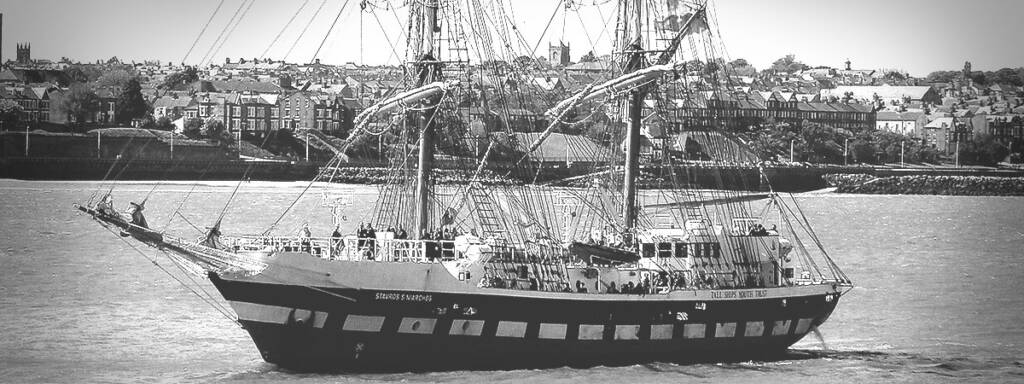
Calflier001 – Stavros R Narchos River Mersey
The maritime history of the twentieth century was shaped by the strategic and personal collision of two men: Aristotle Onassis and Stavros Niarchos. Known as the “Golden Greeks”, they re-engineered the structural foundations of global shipping through offshore holding companies, the systematic use of flags of convenience, and the aggressive use of debt to finance scale.
Their rivalry unfolded as a form of total competition, spanning the Atlantic and the Mediterranean. It played out in the race to build ever-larger supertankers, in the acquisition of private islands, and in the competitive courtship of high-society figures. Beneath the spectacle, however, lay a deeper contest about power, control, and permanence.
This case study examines how their ascent was constructed, how legal and geopolitical crises tested their structures, and why their legacies ultimately diverged.
Displacement vs. Discipline
The trajectories of Onassis and Niarchos offer a masterclass in the intersection of geopolitical volatility and entrepreneurial contrarianism. While both were ethnic Greeks, they emerged from vastly different social strata, which fundamentally colored their leadership styles.
Aristotle Onassis
Born in 1906 in Smyrna, Aristotle Onassis was a product of the cosmopolitan but precarious Ottoman frontier. His life was defined by a traumatic displacement: in 1922, the Great Fire of Smyrna forced his family to flee to Greece as refugees. This loss served as a primary motivator for his emigration to Argentina with only a few hundred dollars in his pocket.
In Buenos Aires, Onassis demonstrated an early talent for identifying arbitrage opportunities. He initially established a tobacco-importing business, but his true maritime insight was the realisation that transporters often earned more than the manufacturers themselves.
Stavros Niarchos
Stavros Niarchos, born in Athens in 1909, came from a background of mercantile stability. His parents had achieved commercial success as naturalised Americans in Buffalo, New York, before returning to Greece. Unlike the self-taught Onassis, Niarchos received a formal education, earning a law degree from the University of Athens.
He entered the shipping world through the grain business of his maternal uncles, the Koumantaros family. This provided him with an analytical foundation: he viewed ship ownership primarily as a way to save on milling transport costs. This “calculated ambition” was fueled by his father’s previous financial ruin, leading him to relentlessly protect himself against worst-case risks.
By the end of the war, both men had learned the same lesson from different lives: states were unreliable, markets were cyclical, and ownership without insulation was fragile. While Onassis sought invisibility to escape the reach of any state, Niarchos sought technical and legal perfection to bulletproof himself against the next collapse. These two distinct forms of insecurity — one born of displacement, the other of discipline — became the blueprints for the global shipping revolution they were about to lead.
The Shared Catalyst
Despite their different origins, both men shared a genius for counter-cyclical investment during the Great Depression:
Onassis: In 1932, he purchased six Canadian freighters for $120,000—a 50% discount on their normal market value.
Niarchos: In 1935, he convinced his uncles to acquire six British freighters at similar bargain prices.
Their wartime experiences further solidified these differences. While Onassis focused on commercial operations and asset preservation, Niarchos served as an officer in the Hellenic Navy. Notably, Niarchos lost six vessels during World War II, but his meticulous over-insurance provided a $2 million payout that funded his rapid post-war re-emergence.
Building a Borderless Empire
The fundamental innovation of the “Golden Greeks” was the decoupling of shipping from national identity. Before Onassis and Niarchos, maritime tradition required a “genuine link” between the owner, the vessel, and the flag state. They shattered this norm to build a borderless empire.
The Invention of the Modern Shipping Model
Onassis pioneered a model built on three pillars: offshore holding companies, flags of convenience, and American debt financing.
- Financial Invisibility: Onassis constructed an intricate web of 164 Panamanian and 19 Liberian companies. He established a separate company for each vessel, creating a “multilayered defense” that insulated individual assets from legal or fiscal liabilities.
- The Debt Leverage Model: In a transformative move with the National City Bank of New York, Onassis used long-term charters with oil majors as collateral for bank loans. This allowed him to expand his fleet exponentially using the bank’s money rather than his own cash.
- The Supertanker Race: Niarchos countered with technical prestige, commissioning increasingly massive “supertankers”. His vessel, the SS Manhattan, became the first merchant ship to transit the Northwest Passage in 1962.
Rivalry as Governance Pressure
The competition between the two men was both commercial and personal, catalysed by their marriages to the daughters of Stavros Livanos, the patriarch of Greek shipping. Onassis married the 17-year-old Tina Livanos in 1946; Niarchos responded by marrying her older sister, Eugenia, in 1947. This created a familial rivalry where the two brothers-in-law were reportedly “sharpening their swords” during Sunday dinners.
Their “yacht and island wars” served as a form of reputation strategy. When Onassis bought the island of Skorpios, Niarchos developed Spetsopoula. Onassis sought the spotlight and public validation, while Niarchos focused on “refined” technical superiority and a world-class art collection.
The Suez Crisis
The 1956 Suez Crisis illustrated the high-stakes nature of their business models. While world shipping was thrown into chaos, Onassis — who held a massive fleet of idle tankers not tied to long-term contracts — was able to set his own prices. He cleared $70 million in a single year (over $700 million today), while Niarchos similarly capitalised on the spot market to reach billionaire status.
The Suez Crisis was the zenith of their private power, but it also marked a shift in their relationship with the world. By 1957, Onassis and Niarchos were geopolitical actors whose wealth rivaled small nations. However, this extreme visibility brought a new kind of risk: aggressive litigation from the U.S. government and a growing need for domestic legitimacy in Greece. They realised that while ships could be seized and charters could expire, institutional legacy was the only asset that could survive both legal attacks and the passage of time. This realisation transformed their rivalry from a race for tonnage into a race for permanence — setting the stage for the two radically different succession models they would eventually leave behind.
Institutional Permanence vs Family Continuity
The true test of any empire is not its construction, but its survival after the founder is gone. For Onassis and Niarchos, the paths to permanence couldn’t have been more different: one chose institutional permanence, while the other chose family integration
As we stand in 2026, the divergent paths of the “Golden Greek” legacies have reached a milestone moment. While both dynasties continue to exert immense influence on Greek society and global philanthropy, the roles of their heirs have shifted into entirely different spheres of public and corporate life.
The Onassis Succession
Aristotle Onassis’s original plan for a direct male succession was shattered by the death of his son, Alexander, in a 1973 plane crash. This tragedy forced a radical restructuring of his legacy through a will.
The Fortune Split
Onassis divided his wealth, leaving 45% to his daughter, Christina, and 55% to establish the Alexander S. Onassis Public Benefit Foundation in Vaduz, Liechtenstein.
The Dual-Entity Design
The foundation was split into two parts: a Business Foundation (a holding company for shipping and real estate) and a Public Benefit Foundation (which receives the profits to fund charitable work).
The “Greybeards” and Succession Drift
Governance was handed to a board of Onassis’s most trusted associates, known as the “Greybeards”. This meritocratic board prioritized the “spirit of the will” over family leadership, eventually blocking Aristotle’s granddaughter and the sole surviving heiress of the Onassis fortune, Athina, from the presidency.
Aristotle Onassis deliberately chose Vaduz, Liechtenstein, as the foundation’s headquarters. This jurisdiction is known for its robust protection of a founder’s specific intent over the claims of heirs. By structuring the foundation as a dual-entity, the “Greybeards” could argue that their primary fiduciary duty was to the institution’s survival, not the heir’s personal preferences.
The board argued that this professional role required specific prerequisites. They asserted that any president must demonstrate a deep connection to Greek culture and language, possess proven business experience to manage a multi-billion dollar shipping and real estate holding, and show an active interest in the foundation’s philanthropic mission.
Because Athina was raised primarily in Switzerland and France and expressed what the board called a “great aversion” to her heritage — famously saying, “I would burn the money if I could” — the trustees claimed she did not meet these foundational criteria.
In 2005, just before Athina’s 21st birthday, the board successfully amended the charter to remove the automatic succession. They replaced it with a merit-based system where the board must vote on the president. This effectively transformed the foundation from a Family Office into a Professional Institution.
While Athina gained control of her private inheritance (the 45% share) at 18, the foundation (the 55% share) remained under the control of the men who had worked with Aristotle for decades. They viewed themselves as the true guardians of his legacy, and Athina as an outsider.
Athina has transitioned from a life focused exclusively on equestrian sports to a formal role in corporate governance. In 2024, she joined the board of directors of the French retail giant Groupe Casino as an independent director. By 2026, she continues to serve on this board, having been re-elected for a three-year term in 2025.
Authority over the Onassis Foundation remains firmly with a meritocratic board of trustees. This confirms the “Institutional Permanence” model Aristotle intended, even as Athina manages her own substantial private wealth.
The Niarchos Succession
In contrast, Stavros Niarchos opted for a model that kept his family at the centre of his legacy when he passed away in 1996.
The Integrated Model
Niarchos left 20% of his fortune to the Stavros Niarchos Foundation (SNF) and the remaining 80% to his children (excluding his daughter Elena Ford).
Co-Presidency
Unlike the Onassis model, the SNF is led by family members, including Philip and Spyros Niarchos, and his great-nephew Andreas Dracopoulos.
Collaborative Impact
This approach fostered a unity that allowed for massive, high-impact projects, such as the $861 million grant for the Stavros Niarchos Foundation Cultural Center (SNFCC) in Athens, gifted to the Greek state in 2017.
In contrast to the Onassis model, the Niarchos dynasty remains a unified, family-led institution that has expanded its reach through collaborative leadership.
30 Years of Impact (2026): In 2026, the Stavros Niarchos Foundation (SNF) marks its 30th anniversary with a yearlong celebration across Greece and globally, culminating in the SNF Nostos 2026 event in Athens.
Governance continues to be steered by the second and third generations. Andreas Dracopoulos (great-nephew) serves as Co-President, while Philip and Spyros Niarchos remain central figures in the foundation’s strategic direction.
The foundation has committed over $1 billion to its Global Health Initiative (GHI). By late 2026, this initiative is expected to complete and hand over three state-of-the-art public hospitals in Thessaloniki, Komotini, and Sparta to the Greek state.
Heirs like Stavros Niarchos III and Eugenie Niarchos remain active in cultural and social circles. The family name stays linked to both modern luxury and the foundation’s organising centre.
The Four Abundances Analysis
To understand why these two dynasties look so different today, we can analyse them through the lens of the Four Abundances, the fundamental pillars of long-term family office success.
1. Wealth
Both tycoons understood that true wealth is preserved through architecture, not just liquidity.
Onassis: Wealth was protected through jurisdictional design in Liechtenstein, creating a hard “firewall” between operating risks and charitable assets.
Niarchos: Wealth was sustained through diversified stewardship, splitting the fortune between the foundation and the heirs, while maintaining a world-class art collection as a high-value asset class.
2. Relationships
This is where the two legacies diverge most sharply.
Onassis: The exclusion of Athina Onassis from the foundation created a century of legal friction and what has been described as a “great aversion” to the family name within the dynasty itself.
Niarchos: By integrating family members—including sons Philip and Spyros and great-nephew Andreas—into the board, the foundation remains a unifying project rather than a site of litigation.
3. Time
The “Golden Greeks” were masters of “time abundance,” using it to outlast market cycles.
Strategic Patience: Both men used long-term charters to finance their fleets, allowing them to wait for global booms or canal closures.
Generational Time: Onassis’s plan was built for a singular successor; when that failed, the governance replaced family continuity. Niarchos, however, converted his time into an intergenerational platform that his heirs continue to lead today.
4. Purpose
The final act for both dynasties was the conversion of commercial wealth into cultural trust.
Institutional Permanence: The Onassis Foundation’s purpose is guarded by a professional board that prioritises the “spirit of the will”.
Active Stewardship: The Niarchos Foundation uses its purpose as a platform for rapid response, such as its $100 million Global Pandemic Relief Initiative and the ongoing $1 billion Global Health Initiative.
How the Canvas Could Have Helped
Using a tool like the Family Council Canvas could have fundamentally altered the trajectories of both the Onassis and Niarchos dynasties. While they were masters of technical and financial engineering, the Canvas addresses the often-ignored “human” questions: What is the wealth for, and how do we prepare the people who will hold it?.
For the Onassis Dynasty
The Onassis legacy suffered from a breakdown in the “Dynamics” and “Compass” segments of family governance.
Defining “Qualification” (Compass): The legal battle over Athina’s eligibility could have been avoided if the “Greybeards” and Aristotle had used the Canvas to codify specific education and experience requirements before the succession event.
Creating a Development Track (Journey): Instead of a sudden exclusion, a Family Council could have built a structured “talent development program” for Athina. This would have provided her with a roadmap for cultural immersion and board apprenticeship, transforming her from a “disengaged heiress” into a prepared steward.
Preserving the Shared Story (Dynamics): The Canvas helps map the emotional consequences of excluding descendants. By using it, the foundation might have anticipated and mitigated the “great aversion” Athina felt toward her heritage, ensuring the legacy was experienced as a gift rather than a burden.
For the Niarchos Dynasty
While the Niarchos family has been more cohesive, the Canvas would serve as a vital tool for their transition into a “Cousin Consortium.”
Role Clarity (Compass): As the family grows, the Canvas helps delineate clear roles between those active in the foundation (like Andreas Dracopoulos) and those active in cultural/social spheres (like Stavros III and Eugenie).
Succession Planning inside the Foundation (Journey): The Canvas allows for the formalisation of how the family wants its public role to evolve—deciding on “privacy vs. presence” and planning for the next generation of co-presidents.
Consensus Building (Goals & Actions): For massive projects like the $1 billion Global Health Initiative, the Canvas ensures that all branches of the family remain aligned on the long-term vision, preventing “quiet rivalries” from disrupting the mission.
Governance Lessons for the Modern Family Office
The history of the Onassis and Niarchos dynasties offers a laboratory for studying how governance design dictates the long-term survival of wealth and family unity. For professional peers in family office management, several actionable insights emerge:
1. Structure Beats Personality Over Time
Both Onassis and Niarchos were exceptional, singular figures whose personalities dominated their eras. However, post-founder outcomes were determined not by their individual brilliance, but by the governance frameworks they left behind.
The Lesson: A family office must transition from a patriarchal “inner circle” to a merit-based system as it grows. Without formal structures, the loss of a founder can lead to “sclerotic inertia” or ruinous fights for spoils.
2. Separate Operating Risk from Mission Assets
The Onassis model provides a strong template for managing high-volatility industries like shipping. By creating a dual-foundation structure (Business vs. Public Benefit), he ensured that the philanthropic mission was insulated from commercial recessions.
The Lesson: Modern family offices can adopt “tiered allocation,” segmenting capital into Core (legacy), Growth (high-risk), and Aspirational (impact) buckets to protect the family’s primary purpose from market shocks.
3. Inclusion Reduces Litigation Risk
The stark contrast in family outcomes highlights the human cost of governance. The Niarchos model—integrating living heirs like Philip, Spyros, and Andreas into the board—has kept the foundation as a point of unity.
The Lesson: Inclusion acts as a “socio-emotional wealth” builder. Involving the next generation in shared decision-making—even in lower-stakes philanthropic settings—builds the legitimacy and skills they will need for full business transitions.
4. Define Eligibility Early
The legal battles over Athina Onassis’s “qualifications” underscore the danger of vague language.
The Lesson: Families must document specific education, business experience, and cultural requirements for heirs before a transition occurs. Using a “Family Council Canvas” can help families align on these criteria, turning “merit” from a weapon of exclusion into a roadmap for development.
5. Purpose as a Durable Asset
Both dynasties ultimately converted commercial power into cultural trust. By gifting massive projects like the Onassis Cardiac Surgery Center or the SNFCC to the Greek state, they secured the family name against the tides of history.
The Lesson: Beyond giving, philanthropy is a strategic tool that stabilises a family’s reputation and provides a “guiding light” for subsequent generations long after original business cycles have shifted.
Closing Words
Aristotle Onassis and Stavros Niarchos built shipping empires that redefined global trade through leverage, risk, and innovation. Yet, decades later, their most visible impact is found in the architecture of their foundations.
Both men understood that wealth alone does not last. Each converted commercial power into institutional form. Where they differed was in their answer to succession. Onassis chose permanence through professional trusteeship, insulating purpose from family volatility. Niarchos chose continuity through family integration, embedding his heirs within the foundation that carried his name.
Neither model is universally right. Each reflects the founder’s relationship to risk, trust, and control. What their stories make clear is that dynastic survival is decided long before the third generation arrives, in the form of choices around inclusion, authority, and structural support.
In the end, ships can be sold, fortunes divided, and influence forgotten. What endures is intention — held, or lost, through the architecture of a legacy.
Disclaimer: This article is a case study based on publicly available information and is intended for educational and informational purposes only. The analysis and opinions expressed are those of the author and do not constitute factual claims about the private lives or intentions of the individuals discussed. The use of any copyrighted material is done for the purposes of commentary and criticism and is believed to fall under the principles of fair use. All images are used with attribution to their known sources.
References:
Athens Insider (n.d.). Onassis and Niarchos: A Duel in the Sun. [Online] Available at: https://www.athensinsider.com/onassis-and-niarchos-a-duel-in-the-sun/ (Accessed: 19 January 2026).
Biography.com (n.d.). Aristotle Onassis. [Online] Available at: https://www.biography.com/celebrities/aristotle-onassis (Accessed: 19 January 2026).
Chrysopoulos, P. (2024). Retail Giant Welcomes Athina Onassis to Board. Greek Reporter. [Online] Available at: https://greekreporter.com/2024/10/04/athina-onassis-board-directors-french-supermarket-chain/ (Accessed: 19 January 2026).
Geneanet (n.d.). Stavros Livanos (1891–1963). [Online] Available at: https://gw.geneanet.org/wikifrat?lang=en&n=livanos&p=stavros (Accessed: 19 January 2026).
Greek Shipping Hall of Fame (n.d.). Stavros S. Niarchos (1909–1996). [Online] Available at: https://greekshippinghalloffame.org/?inductee=sniarchos-en (Accessed: 19 January 2026).
Harlaftis, G. (2019). Innovation in Global Shipping: The Onassis Business, 1946–1975. Cambridge: Cambridge University Press. [Online] Available at:(https://www.cambridge.org/core/books/creating-global-shipping/innovation-in-global-shipping-the-onassis-business-19461975/BF467F534CE8ED6CF21A798E94D42C6D) (Accessed: 19 January 2026).
Kampouris, N. (2023). Onassis vs. Niarchos: The Battle of the Legendary Greek Tycoons. Greek Reporter. [Online] Available at: https://greekreporter.com/2023/07/28/onassis-niarchos-greek-tycoons/ (Accessed: 19 January 2026).
Onassis Foundation (n.d.). Public Benefit Foundation: History and Pillars. [Online] Available at: https://www.onassis.org/foundation/public-benefit-foundation (Accessed: 19 January 2026).
Stavros Niarchos Foundation (n.d.). SNF: Our Founder. [Online] Available at: https://www.snf.org/en/about/identity/founder/ (Accessed: 19 January 2026).
Superyacht Fan (n.d.). Philip Niarchos: Net Worth and Art Collection. [Online] Available at: https://www.superyachtfan.com/yacht/atlantis-ii/owner/ (Accessed: 19 January 2026).
Wikipedia (n.d.). Alexander S. Onassis Foundation. [Online] Available at:(https://en.wikipedia.org/wiki/Alexander_S._Onassis_Foundation) (Accessed: 19 January 2026).
Wikipedia (n.d.). Aristotle Onassis. [Online] Available at: https://en.wikipedia.org/wiki/Aristotle_Onassis (Accessed: 19 January 2026).
